JOBS: Jumpstart Our Business Startups Act. Legalizing Fraud in the Stock Market. Interview of Matt Taibbi by Eliot Spitzer on Viewpoint, Current TV, April 9, 2012. Video and Transcript.

Get the Flash Player to see this content.

Yesterday, Matt Taibbi, contributing editor at Rolling Stone, published an article entitled, “Why Obama’s JOBS Act Couldn’t Suck Worse”.  The following is an interview of Matt Taibbi on the subject of the JOBS Act, conducted by Eliot Spitzer on Viewpoint at Current TV on April 9, 2012.

Eliot Spitzer:  Last Thursday President Obama signed the so-called Jobs Act.  I call it the Return Fraud to Wall Street Act.  In his Rolling Stone blog this week, Matt Taibbi points out that not only is the name, Jumpstart Our Business Startups Act, annoying and redundant but also the act itself will invite “a replay of the disastrous tech-stock bubble of the late 1990s.”

Joining me now is a man who will always be famous for one of the greatest metaphors of all time, describing Goldman Sachs as “a great vampire squid wrapped around the face of humanity”, Rolling Stone contributing editor, Matt Taibbi.

Matt, it is great to have you here.  Your articles are always spectacular.   You have a metaphor here; I will get to it in a little bit but first you have been so critical of this Act.  Tell us what people on Wall Street said about this Act.

Matt Taibbi:  I had a friend call me up this weekend basically and he didn’t even say anything on the phone…when I answered the phone he was just laughing hysterically uh… basically the upshot of it is that people just can’t believe how far they went in breaking down all the regulations that were enacted after the collapse of the stock bubble in the late nineties.  It’s just they’ve gone so far it almost boggles the mind.

Eliot Spitzer:   You know, it seems as though our short-term memory has diminished to absolutely nothing.  And you hear the President and leaders down in Washington all the time talking about fairness and enforcement, and then they pass a law that effectively repeals half of the meaningful rules that were put in place to prevent another bubble from being inflated.  What is their logic?  I mean, how do they rationalize this?

Matt Taibbi:  It doesn’t make any sense at all because really the stock market was one of the few markets that wasn’t a complete and total disaster and ripe with corruption.  And it’s the one place where America still had a relative competitive advantage relative to the rest of the world because investors around the world know that companies that are on the stock market have to conform to some basic regulations and the numbers that they submit are at least in the ballpark of reality.  Now all of that goes out the window.   Now there is no competitive advantage anymore.

Eliot Spitzer:   You give us the examples of this law now saying that new companies with valuations under a billion revenues won’t need to have certified public accountant records to validate their claims.  Why did they think that will help people raise money?

Matt Taibbi:  It doesn’t make any sense.  The analogy that I gave would be like announcing that all baseball rookies would be exempt from steroid testing for the the first five years of their career.  Sure, you are going to get a lot of home runs uh…for those first five years but you’re going to have to have a lot of asterisks in the record books afterwards as well.  It just doesn’t make any sense.  It is completely flawed logic.  They really think that if they don’t pass laws like this, that companies are going to flee to other jurisdictions.  But the reality is you don’t want a company that’s going to commit fraud to come here so that they can commit fraud.

Eliot Spitzer:   When I read the article that actually was the metaphor I just loved.   It is just like saying, look for the first five years you don’t need to tell us the truth.   You can just tell us whatever you want us to believe, and the example these days is Groupon, which was and is in the midst of an IPO, I suppose.  Its accounting has been subject to all sorts of attack.  Had this law been in existence, none of those issues could have come to light.

Matt Taibbi:  Right, and it places honest companies at an active disadvantage because they’re expending all this energy trying to conform and make all the numbers really add up whereas this other company can just make up all the numbers and go to investors and say “uh… here’s some numbers that we just cooked up and you’re free to believe them or not.  So there’s no emphasis now on being honest and actually conforming to the rules.

Eliot Spitzer:   Look, Wall Street went down to Washington and lobbied extremely hard to repeal the rules that were working.  Political question:  why did the President,  who was now running as a populist wisely or not, and a Democratic party that is trying to go back to its base and say we are protecting you from the avarice of Wall Street, why did they pass this almost in the dark of night?

Matt Taibbi:  It doesn’t make any sense at all.  Again politically it makes no sense because Obama is in a position where he basically has an election that he cannot lose:  it’s his to lose.  The only thing that could really happen is if he makes a mistake.  That’s the only way he can lose this election.  And here he goes and he hands an issue to the Republican nominee.  Basically an opponent can look at this Act and say Obama just gave a gigantic handout to Wall Street and made a return to the fraudulent days of the late nineties possible again.

Eliot Spitzer:   And I see such a huge tension between the argument that he’s trying to make—and he has been making it quite effectively—that he’s going to bring back some degree of rigor, some degree of integrity, transparency, to the markets, and then behind the mask of permitting capital formation a bit more rapidly we exempt companies from the obligations to tell us the truth about their financials.  I simply don’t see how you square those two arguments.

Matt Taibbi:  Sure, it rolls back elements of Dodd-Frank, it rolls back elements of Sarbanes Oxley, it roles back all these important regulations, it rolls back some of the work that you did obviously after the global settlement, all these things that Democrats theoretically have worked for over the past decade; and now it all goes out the window.  Why?  It doesn’t make any sense.

Eliot Spitzer:   And frankly I have never seen any real evidence that those rules prevent capital formation, despite all the rhetoric, despite all the talk from the other side, I have never seen one piece of evidence that substantiates their view.

Matt Taibbi:  The best excuse that they’ve given for why they need to eliminate this independent accounting rule is that it costs too much to hire accountants.   Are you really going to invest in a company that cannot afford to hire an independent accountant?   That doesn’t make any sense at all.  That just shows you how dishonest the law is if that’s the real excuse.

Eliot Spitzer:   Maybe they should have told that to the victims of the Madoff Ponzi scheme,  who also didn’t have an accountant.  Maybe we will bring Bernie Madoff back.  I guess he was supporting this bill.  Who knows.    Rolling Stone contributing editor, Matt Taibbi, thank you so much for your time tonight.

Transcribed by The Barefoot Accountant

Accountants CPA Hartford, Connecticut, LLC

Certified Public Accountant

Certified QuickBooks ProAdvisor

Berlin, Connecticut

Posted in Accountants CPA Hartford, Articles | Tagged , , , , , , , , , , , , , , , , | 1 Comment

Matt Taibbi discusses his recent article, Bank of America: Too Crooked to Fail, on Democracy Now, March 22, 2012. Video with review.

Get the Flash Player to see this content.

[Loose transcription of interview on March 22, 2012 on Democracy Now]

In his new article, “Bank of America: Too Crooked to Fail,” Rolling Stone reporter Matt Taibbi describes how the Bush and Obama administrations have repeatedly helped keep Bank of America alive, propping it up with a $45 billion taxpayer bailout in 2008 as well as providing it with billions in “shadow bailouts” since then, despite Bank of America’s long record of what Taibbi describes as defrauding, quote, “everyone from investors and insurers to homeowners and the unemployed.”  Taibbi also recounts how fraudulent practices by Bank of America and other companies ravaged pension funds.  One hedge fund manager told Matt Taibbi of Rolling Stone that Bank of America’s mortgage fraud resulted in, quote, “one of the biggest reverse transfers of wealth in history — from pensioners to financiers.”  “Most people think of [the mortgage crisis] as some airy abstraction — you know, bankers ripping off bankers,” Taibbi says. “That’s not what it is. It’s bankers stealing from old ladies and retirees.”    

In February, the Obama administration announced Bank of America and four other large banks had signed on to a $25 billion mortgage settlement to resolve claims over faulty foreclosures and the mishandling of requests for loan modifications. President Obama described it as a landmark settlement. But is the settlement for the benefit of those scammed or the scammers?

The deal is narrowly only supposed to cover a small part of the problems with the mortgages that went on during the crisis. It is only supposed to cover robo-signing.  Robo-signing is the practice of a bank employee signing thousands of documents and affidavits without verifying the information contained in the document or affidavit.   Rather than actually reviewing the individual details of each case, robo-signers assume the paperwork to be correct and sign it automatically, like robots.

The banks were lending billions of dollars to companies like Countrywide to make loans all over the place to anybody with a pulse.  After these mortgage companies made these billions of dollars’ worth of loans, these Countrywide-type companies would then sell the loans back to a big bank like Goldman Sachs or Bank of America, who in turn would chop up these loans, turn them into securities, and ultimately sell them off to customers like unions and pension funds and foreign retirement funds all over the world. Because they were not like traditional bankers who would hold onto and service these loans over 20 to 30 years, they just simply stopped doing the paperwork on these loans. It was not cost-effective for them. Essentially they just completely stopped servicing the loans.  Only when they had to foreclose would they go back and try to reconstitute that evidence.  They would just assign a bunch of sort of entry-level people to make up affidavits so that they could go to court and foreclose on people. Of course, this was completely illegal. It was really a system of mass perjury. That is what this $25 billion settlement is supposed to cover, strictly the fraud in that one narrow area of this process. 

There are much, much bigger problems in the areas of creating loans and securitizing the loans. That’s where the real fraud occurred. The real fraud was when Bank of America or some company went to a union and said, for instance, “Here’s a whole bunch of mortgages we want you to buy. They’re AAA-rated. They’re all good.” And they left out derogatory information about how bad the loans really were. That was the real fraud. That supposedly is not covered by this settlement. But there’s some ambiguity about what this settlement covers. Some people think it does cover more than the robo-signing. And if it does, if there is a waiver for more than just robo-signing, then it would be an incredible giveaway to the banks. It might even be a bigger bailout than TARP. 

And this is, of course, extremely important to these pension funds, which were such huge investors, the California retirement and New York retirement funds, because they have all experienced huge losses. And now local government officials are reducing pension benefits because of the need to put in more money to these pension funds. So if they cannot recover from the fraud, it’s working people that are going to suffer in their pensions. 

That is what people don’t understand about this mortgage crisis. Most people think of it as some airy abstraction, bankers ripping off bankers. That is not what it is. It is bankers stealing from old ladies and retirees. That is what it is. They essentially went to pension funds, and they said, “Here’s a whole bunch of relatively safe, AAA-rated investments. AAA, that’s the same quality as United States T-bills or the sovereign debt of Luxembourg or something like that. It just earns you a little bit more, but it’s also AAA.” They bought this stuff. And then, a year or two later, they were looking at 30, 40, 50 percent losses. And that’s just money that’s coming straight out of the pockets of old people and retirees. 

Now, the problem is, are they going to be able to recover any of that money from the banks? With settlements like this, it just makes it that much harder for them to do that. And even though a lot of them have won settlements against these banks—New York State and New York City both won a settlement against Bank of America, $624 million—typically, it’s for pennies on the dollar. They only recover a small percentage of what they’re really owed. 

Matt Taibbi’s article contains a laundry list of illegal activities that Bank of America has been involved in, including a ripping off of the unemployed.  He asserts that there were a number of different scams they were involved with. 

According to him, one of the two most incredible scams involves municipal bid rigging.  In fact, Bank of America a couple years ago paid a $137 million settlement, because they were caught rigging the bids for municipal bond issues in at least 88 different cases across  25 different states. What this means is whenever some municipality, such as the City of Baltimore, wants to raise money, it would have to do it through an investment bank, and it is supposed to do it through an auction process, where all the banks compete to see how much they’re going to pay to get that business. Well, these banks have been systematically colluding and submitting artificially low bids, and there’s usually an insider on the municipal side who kind of games the whole process. They’ve been systematically doing this around the country for years and essentially cheating municipalities out of hundreds of millions of dollars in revenues that they would have otherwise gotten. That’s a big one. 

The other big one, that’s more of a recent story, is Bank of America has been accused, along with a number of other banks, of artificially suppressing LIBOR, which is the London interbank exchange rate. LIBOR is basically the exchange rate upon which all adjustable rate investment vehicles are based on: mortgages, credit cards, everything. They’ve been artificially suppressing LIBOR so as not to pay out as much to any investor who has a LIBOR-based instrument. There’s $350 trillion worth of investments are based on LIBOR. So they’ve been gaming the game, essentially. There’s really nothing that these guys haven’t been involved with. 

As mentioned above, Bank of America was cheating the unemployed.  The bank has a contract in a number of states to distribute unemployment insurance benefits. People would get a prepaid Bank of America card.  In South Carolina, it was discovered that if the people getting the benefits did not go to a Bank of America ATM machine, that they could pay fees as high as $10 for each time they went to either a bank or another ATM. 

And other states, like Iowa and Oregon, and churches, like the United Methodist Church, are experiencing similar issues with Bank of America.  When the banks were packaging mortgages, they offered a kind of guarantee to investors. They said, “Not only do we personally guarantee that these mortgages met our underwriting standards, we also agree that if any of these mortgages are defective or in default … at the time of purchase, we promise to buy those mortgages back. So don’t worry about it. Buy this stuff. If anything is wrong, just come back to us. We’ll pay you.” And a lot of these lawsuits, like the United Methodist Church, like the State of Iowa, State of Maine pension funds, they looked at the stuff that they were buying, and they found that a sizable percentage of these mortgages were defective. And they went to go get their buybacks, but suddenly Bank of America is not answering the telephone. And that is what a lot of these lawsuits are about. They are contractually obligated to buy this stuff back, and they are just not doing it. And so, that is another thing that people are worried about they might get out of because of this foreclosure settlement and other settlements like that. 

Occupy Wall Street, over the winter, wanted to put a specific face on some of the issues that they were talking about. You know, in the fall, people had a sort of abstract conception of what they were protesting against. They wanted to say, “Let’s take a specific case of a specific actor, and let’s show people what these companies are really all about.” And there was some discussion over what company they should pick. And the almost universal consensus of all the experts that they talked to was, “You should go for Bank of America, because they’re involved in everything,” you know, whether it’s ripping off student loans, to the unemployed, to pensioners, to depositors. Bank of America got caught systematically overcharging its depositors by $4 billion. So they organized a series of protests. And there’s a campaign afoot to try to get people to move their money out of Bank of America. And this is going to be something that they’re going to focus on for the immediate future. 

Given the laundry list of all of these illegal activities, the trillion-dollar question is why is the government and the Obama administration not shutting this bank down, instead of continuing to prop it up with federal support? 

There is a rationale that one can maybe see for supporting some other companies, some of these other “too big to fail” companies, because they might be functional, thriving companies with a little bit of help. Bank of America has consistently made bad decisions, in addition to all these corruption—all these activities that they’ve been involved with. Without government support, they would have been out of business absolutely in 2008, because of all the problems associated with Countrywide. They have needed massive government support ever since. 

Just last year, they were in a very delicate situation where a number of their counterparties and creditors were concerned about the massive flow of derivatives that were on Merrill Lynch’s books. They convinced Bank of America to move that stuff onto its own depository side so it would be federally insured. So now we’re all on the hook for all this stuff. And that’s another thing that—another way that they’ve used the government to get out of their private problems. It’s just there’s an ongoing support of this company, and I think our administration believes that they have to support these companies at all costs.

Video and review/transcription provided here by The Barefoot Accountant

Accountants CPA Hartford, Connecticut, LLC

Certified Public Accountant

Certified QuickBooks ProAdvisor

Posted in Accountants CPA Hartford, Articles | Tagged , , , , , , , | 2 Comments

Cenk Uygur interviews Matt Taibbi from Rolling Stone on Current TV on Bank of America being too crooked to fail, March 22, 2012: bid rigging and sale of poor quality mortgage-backed securities. Video and transcript.

Get the Flash Player to see this content.

Cenk Uygur:  We are going to talk to Matt Taibbi from Rolling Stone about a great piece on Bank of America being too crooked to fail…. 

$230 billion doesn’t begin to cover the level of fraud of Bank of America.  In fact, Countrywide was taken over by Bank of America.  And in Matt Taibbi’s news piece there is a stunning fact:  “a staggering 97% of the [Countrywide] loans didn’t meet the stated underwriting standards.”  So meaning 97% of them  were in someway fraudulent.  Is that a large enough number for you? 

And then the list of frauds that Bank of America has done is so large but let me give you just one sense of it here.  Bank of America paid a hundred and thirty seven million dollar fine for its sabotage of the government contracting process.  Now Matt points out that’s what mobsters used to do to rig bid on garbage collection, etc., etc.  It was a terrible crime; you went to jail for it.  Bank of America does it, they admit it, they pay a fine for it, and they are free to go.  And they do it all the time. 

Meanwhile what do the Republicans think?  Of course, we were supposed to bailout the banks.  Look at Mitt Romney on the campaign trail: 

“There was a fear that the whole economic system of America would collapse; that all of our banks, or virtually all, would go out of business.  And in that circumstance, President Bush and Hank Paulson said we got to do something to show that we are not going to let the whole system go out of business.  I think they were right.  I know some people disagree with me.  I think they were right to do that.” 

Cenk Uygur:  All right, well, Matt Taibbi of Rolling Stone is going to join us to tell us whether Mitt Romney is right or not.  I see you shaking your head already, Matt.  Go for it.  Is Mitt Romney wrong? 

Matt Taibbi:  Well you know what, I could almost see the argument that in two thousand eight when the government was blindsided by all the problems that happened uh… and all these companies were in trouble Lehman Brothers and Citigroup and Goldman Sachs and Bear Stearns, I can almost see the rationale of coming in and saving some of these companies temporarily, uh… but not only did they not go in and take these companies over and fire all the people who were responsible for all of this fraud, they continued to support this company for years after they had already put it back on its feet, and that to me is what the most inexcusable part of it is.  It’s one thing that they gave it forty five billion dollars in two thousand eight, but they kept supporting it uh… with billions and billions of dollars of low interest loans after that, and that’s the real problem. 

Cenk Uygur:  So basically there were no strings attached and you know, and I think a lot of people look at that, and they look at that from a simplistic point of view because unfortunately a lot of media has covered it that way:  well, the banks took some money and then they paid it back and they are fine and they’re all upstanding citizens who, you know, make these million dollar contracts, etc., because they are geniuses.  Well, you know, your story says that might not exactly be the case.  So tell the people watching at home why do you think Bank of America, among the others, actually does fraud, does things that are criminal and should be, you know, it is not normal business that they should be rewarded for. 

Matt Taibbi:  First of all let me just back up with that that popular perception that these guys are really smart and they’re making their money honestly and they paid the money back.  These banks are essentially getting their money for free from the Federal Reserve.  Bank of America at one point had owed the Federal Reserve as much as ninety billion dollars.  They have basically this endless tap of zero interest loans from the Fed.

In banking the entire business is all about cost of capital.  If your cost of capital is zero, it’s virtually impossible not to make money.  Think about it.  They’re getting their money at zero from the government for letting it out to us at five percent for mortgages or fifteen percent for credit cards. How do you not make money when you have an endless supply of free money?  And that’s what uh… all these banks have been doing all these years.  They just simply go to the Fed,  they get a bunch of money, and then they lend it out to us, and they take the cut.  And that’s what they’ve been doing, before we talk about the fraud right. 

Cenk Uygur:  So the genius they had was, “hey, I got it.  It turns out I can buy American politicians.  And if I buy them, they give me free money, and with free money, I can’t lose.”   That’s the only thing they figured out. That our system is unfortunately deeply corrupt.  Now talk to me about the fraud and whether what they’re doing is, you know, in some way illegal or is corrupt. 

Matt Taibbi:  It’s totally illegal.  First you have to go back to two thousand eight, two thousand seven, two thousand six, that period.  What Bank of America and what all the big banks were involved in essentially was a giant fraud scheme.  It’s no different than here in the streets of New York where you see people selling fake Prada bags out in the street or phony blue jeans.  What they were doing was selling phony mortgages.  They were taking really poor mortgages, sub-prime mortgages of very poor quality lent out to extremely risky borrowers, and they were disguising them as Triple-A rated high quality loans.  They were essentially lending out home mortgages to everybody with a pulse.  They were taking those loans, chopping them up, and then selling them off to unsuspecting unions and pensions and foreign retirement funds, representing them as these high quality securities.   It was a giant fraud scheme.  They were doing this all over the world, and as part of these deals, they were required to buy back any defective loans that were in default, and that’s what Bank of America is facing right now.  They’re supposed to be buying back all these bad loans and they’re not doing it.  And there is this gigantic string of outraged customers knocking on their door demanding their money back.  

Cenk Uygur:  So opens up to things that are really important.  One is who did they rip off.  And as you explain, and again not explained nearly well enough in the rest of the media, it was the pensions.  And I talked to Nomi Prince, who used to be the managing director at Goldman Sachs, she said that’s the suckers at the table.   When you go to rob people, who do you go to rob?  The average American and their pensions.   So what did they do to the pensions? 

Matt Taibbi:  Look, who buys these mortgage-backed securities?  The customers were these big institutional investors and a very typical customer was like a state pension fund, the New York State Pension Fund, the New York City Retirement Fund, the Los Angeles County Retirees, the State of Mississippi Retirement Fund.  All these people went to Bank of America and they bought mortgage-backed securities that they thought were very high quality.  What people need to understand is that the fraud on Wall Street, they think it’s some abstraction, bankers ripping off other bankers, it’s some kind of insider trading scheme where it’s a victimless crime.  That’s not what it is.  It’s bankers ripping off old people and retirees.  They are essentially stealing their life savings and that’s what went on in two thousand six, two thousand seven, two thousand eight and beyond, and they still have not paid the money back.  

Cenk Uygur:  Now that’s the case of mortgages right, where they rip off the retirees, etc.  And then there’s the case of the municipal bonds where they rip off the local cities and then counties like Jefferson County in Alabama, go bankrupt, and then everybody loses their money.   They take the money from someone, and ultimately it is us that they take it from.   But Matt, as I am reading your long piece here, constantly the thing that they come back to is that there’s never any consequences.  They are in essence too big to comply.  Because they turn to government and say, “what are you going to do about it?”    

Matt Taibbi:  Yes, just this week we found out that the number one recipients of municipal bond business in America, the number one in two companies are still Chase and Bank of America, and those two companies both have paid hundred million dollar settlements for bid rigging.   Chase got caught in twenty five different states rigging municipal bids, and Bank of America got caught rigging at least eighty eight different bids in different municipalities.  And again this is not a victimless crime.  If your town wants to raise money and issue a bond to build a new basketball court or a school and they [the banks] are paying a million dollars instead of three million dollars for the [town’s] investment banking business, well that money eventually is going to come out of your pocket.  They are going to raise taxes to make up that money that they didn’t make from the banks.  So they are paying artificially low bids for these contracts and they’re doing it all over the country. 

Cenk Uygur:  Like you wrote, that’s what the mob used to do.  One last thing I have to ask you about.  So where does the money go.  All these people get ripped off.  Where does the money wind up?  

It’s interesting in 2011 Bank of America got over a billion dollars in a tax rebate.  They didn’t  pay any taxes.  In fact, they got a billion dollars back.  Why?  Because they said they got out $5.4 billion in losses in the earlier year.  Well the problem is that they paid $35 billion in bonuses and compensation.  So when you look at that, Matt, isn’t it obvious that the executives are just taking the money and putting in their pocket and then they go, oh, look at that, we had no profit, ha ha ha. 

Matt Taibbi:  Oh yeah, absolutely, that’s exactly what goes on.  And if it’s not converted into profits and bonuses they just leave it offshore:   that’s another method of dealing with the whole tax problem.  Bank of America last year, I think,  had seventeen billion dollars in revenues that stayed off shore.  So if they don’t want to pay taxes, they just issue bigger bonuses and leave their money overseas,  and they don’t pay taxes.  They didn’t pay a single dime last year or the year before in taxes which is an extraordinary  testament to the holes in the system.  

Cenk Uygur:  All right.  Matt Taibbi shedding light on this at Rolling Stone.  Great job.  Thank you so much for joining us.  Really appreciate it.  And let me just say this is one of the largest thefts in American history.  It is happening right under our nose and it is happening right now.  That’s what you got to know.  Not something that happened in the past. 

Transcribed by The Barefoot Accountant

Accountants CPA Hartford, Connecticut, LLC

Certified Public Accountant

Certified QuickBooks ProAdvisor

Now do you still think that the Occupy Wall Street protesters are a bunch of crazy commies?!

Posted in Accountants CPA Hartford, Articles | Tagged , , , , , , , , , , , , , , , , | Leave a comment

Damning Report: Obama And The Grand Bargain. Cenk Uygur video Current TV March 20, 2012

The Washington Post reveals the inside scoop on the grand bargain last year and currently under consideration, affirming that President Obama, indeed, wants to cut corporate taxes while making up for the deficits by cutting social security, medicare, medicaid, healthcare, and other safety-net social programs yet raising taxes on the working and middle classes.  President Barack Obama is not a progressive President.

Obama’s top advisors of the grand bargain—the deficit-debt cutting deal last July—included William Daley, Chief of Staff, Treasury Secretary Tim Geithner, budget director Lew Jacobs, and Rob Nabors, the legislative liaison.  Obama was negotiating this deal with John Boehner and Eric Kantor.  The Republicans wanted Obama to give up plans to raise the highest marginal tax rate on the rich from 35%; rather, they wanted him to lower that tax rate as well as preserve the low capital gain rates on investment income, one of the biggest perks for the wealthy in the tax code, and exempt corporate profits from overseas from U.S. taxes.

In essence, the Republicans wanted Obama to cut social security, medicare, Medicaid, healthcare, and other social programs and in return for such, cut all the taxes on the rich, Wall Streeters, and multinational corporations.  The question is:  where was the deal here?  Even though they were cutting taxes in three different ways for the rich, Wall Streeters, and multinational corporations, they were not willing to raise taxes, but were merely willing, so to speak, to “simplify the tax code”, and rely on supply side economics (i.e., dynamic scoring) to provide a projected increase of $800 billion in governmental revenues.

What is surprising to many Democrats is that Obama accepted this Republican proposal; however, John Boehner, after conferring with Republicans, ultimately backed out of the deal since it was apparently not enough to appease House Republicans.  But White House administration officials announced this week that the deal is still on the table!!!

In summary, the deal is simply the following:  the Republicans get cuts to social security, medicare, Medicaid, healthcare, and other safety-net social programs that they demanded while they also get lower taxes on the rich, corporations, Wall Streeters, and multinational corporations that they desired.  What do the working and middle classes get from the Democrats negotiating on their behalf from this deal?  Nothing!  Nada!

Where is the “grand bargain”?  Where is the deal?  The rich and elite get lower taxes while the working and middle classes suffer more spending cuts to their social security, medicare, Medicaid, healthcare, and other benefits.

Has Obama forgotten what political party he belongs to?  Or have all Congressional Democrats and Democratic Presidents moved so far to the right that they are now indistinguishable monetarily and fiscally from their corporate Republican counterparts?

The Barefoot Accountant


Posted in Accountants CPA Hartford, Articles | Tagged , , , , , | 2 Comments

Should Progressives now fall in line behind President Obama just because an election is coming up?

Get the Flash Player to see this content.

progressives against ObamaWe seemed to have entered an era where there is this group think of that no matter what you think of President Obama, in reality everybody needs to get in line and make sure that they follow whatever the President says because we are heading toward an election.  And I simply don’t agree with that.  

It seems like there is always an excuse of, it’s such a hard job, so progressives have to give President Obama all the breaks.  

Martin Sheen recently said, “It’s unrealistic.  I wonder how many of those progessives [meaning the ones that are criticizing him] are black?  How many of those progressives understand historically what happened?” 

So does that mean only Cornel West can criticize the President?  That you have to be black to be able to do a progressive criticism of the President?  I don’t think that that makes any sense at all, and that’s a needless injection of racism into this issue when it does not belong there. 

Here are some things that really concern me.  Recently I read in the news again about how they might be bringing back the “grand bargain”.   Do you remember what this is?  This is basically the Simpson-Bowles Commission that the President asked for and has been lobbying for and has wanted to do all along.  But do you remember the downsides of that? 

First of all, in this so-called grand bargain on the budget, they would do three times as many spending cuts as they would do so-called tax increases.  Now as a progressive, why in the world would I be in favor of that?  That’s a terrible ratio.  We already cut spending to the bone; he’s going to cut three times more than the tax increases.  I don’t agree with that.  I don’t care that we are heading toward an election.  That’s the wrong plan.  And in fact it doesn’t help his election chances at all; it would totally hurt him. 

Now here’s more downsides of the grand bargain.  It cuts social security.  It cuts medicaid.  It raises taxes for the poor.  It raises taxes for the middle class.  That’s where your tax raises are.  And it lowers corporate taxes.  To which I say, hell no. 

I am not going to get in line for that.  It doesn’t mean that I prefer Mitt Romney or Newt Gingrich or any of the other clowns.  No one is saying that.  But I am not going to sign onto something because the President is running for re-election.  Hell no.  I hope to God that they don’t do the grand bargain. 

Now when you look at President Obama in his entirety, it’s a complicated picture.  There’s definitely been upsides.  Let’s talk about the upsides for a second.  

They did healthcare reform.  I have my concerns about it but it’s at least 50% good and it was a big, big effort.  

There’s some defense spending cuts.  I would love more but there is some. 

On women’s rights, I actually think that he has been terrific:  fair pay act; affordable care act.

He stopped torture.  He has been terrible on civil liberties otherwise.  But he did shut down the black sites that the CIA was running and that stopped torture.  

He saved the auto industry. 

There was a stimulus.  It could have been larger, but it had significant effects on unemployment in bringing it down. 

Obviously he killed Osama bin Laden which was terrific. 

And he finally got rid of don’t ask don’t tell.  Again, that’s very, very good. 

But you also have to look at the downsides.  And let me give you a quick list of that as well. 

He was very easy on the banks. 

At the same time he was hard on whistleblowers:  not just Bradley Manning but corporate whistleblowers and other security interests whistleblowers. 

On civil liberties, honestly, I thought that he was a disaster.  National Defense Authorization Act, that allows for arresting U.S. citizens and giving them indefinite detention, which is terrible.  Warrantless wiretapping continues.  Drones on U.S. citizens, where he killed them without any due process. 

Domestic spending cuts have been significant, dramatic. 

The war on drugs.  He started out great in the first few years and then he turned around and doubled down on the Bush administration policies, busting dispensers in the states for no reason. 

And on immigration reform he has been horrible.  He has deported more people than George W. Bush did.  

And then my main beef with him, nothing on campaign finance reform, nothing.  He was supposed to change the system.  

So don’t have people tell you that you got to bow your head and go along. 

So if you are a progressive, Obama supporters will tell you because we are heading into an election, you should not criticize the President.  But it’s maddening to me that President Obama constantly goes to the right and it doesn’t help him politically.

The Barefoot Accountant

Posted in Accountants CPA Hartford, Articles | Tagged , , , , , , , , , , , , , , , , , , | 1 Comment

Does President Obama have the right economic plan overall?

Get the Flash Player to see this content.

Cenk Uygur:  Does President Obama have the right economic plan overall?  I’m not so sure.

Jimmy Dore:  No, he doesn’t have the right plan overall.  I don’t even know how these jobs are being created right now because he is not proposing measures to fix our problems.  And by the way, it’s good news that we created those jobs but that’s not even half of what we need to keep up….He’s not even proposing solutions to our problems.  He’s still not.  I’ve heard a lot of economists say that they are afraid of the [employment] numbers going back down again. 

Cenk Uygur:  At this rate, including the population growth, in order to get back to where we were, we still lost 5 million jobs overall in the recession, it would take till about 2087, I’m exaggerating, but an unbelievable period of time.

But in the long term, I am afraid that we have not solved any of the underlying problems.  We still have all of these houses underwater, trillions of dollars worth, and we didn’t address that.  We didn’t hold any of the bankers accountable; they can still take those crazy risks.  I am afraid that that’s going to blow up the economy at any given time.

Jimmy Dore:  When you say that he had initiatives for creating jobs …how many jobs was that projected to create?  A million or two jobs?  We needed twenty-five million jobs.

Cenk Uygur:  I think Jimmy is right here.  President Obama had a decision to make right in the beginning.  was he going to go large:  hey, we are going to do a smart energy grid; we are going to do transportation on a grand scale, which we needed.  We needed infrastructure on a grand scale.  He chose not to because he was afraid of Republican reaction.  God, I wish he made a different decision.

[The discussion now concerns Obama’s healthcare bill.]

Michael Shure:  …If there is an area of Obama policy where I believe that he did not go far enough, it is with Obamacare.  There was a poll taken in September of 2010, before the Congress turned over that November, that showed that the people who thought that the healthcare plan was too conservative outweighed those who did not like it by two to one.  That was an Associated Press poll.  People liked the healthcare then.  The Obama team did a terrible job, as you said over and over, of selling it, and of being on the offense and then going far enough.

Jimmy Dore:  …Wasn’t that a mistake to not implement [all of the healthcare benefits] right away [instead of deferring them to 2014]?

Cenk Uygur:  I always thought that waiting till 2014 was a terrible idea….But I think it was the wrong decision honestly.

Posted in Accountants CPA Hartford, Articles | Tagged , , , , , , , , , , , , | Leave a comment

A tale of two Obamas: Dr. Jeckyll in a campaign; Mr. Hyde in office. Whatever happened to the fierce urgency of now?


President Obama is Dr. Jekyll and Mr. Hyde


There are two Obamas: the one as a progressive candidate, calling for immediate change; and the other as a conservative Democrat, appointing Wall Streeters as his top economic advisors. The campaigner speaking on behalf of Main Street; and the President catering to Wall Street.

What follows is a selective, partial, loose “transcription” of Cenk Uygur’s thoughts on the two Obamas.

Cenk Uygur:  I want to discuss something that Arianna Huffington brought up on the Huffington Post:  Obama versus Obama.  The campaign Obama, whom we all like and was a wonderful progressive; we didn’t agree with everything that he said on the campaign but overall we take it; in fact, that is how we voted.  Governing Obama, a little different.

Now we put together here a compilation of the two different Obamas.  Watch for yourself.

[While campaigning for President, Obama said about Guantanomo:]

Obama:  We are going to lead by shutting down Guantanomo and restoring habeous corpus in this country.

[But while governing as President, Obama said about Guantanomo:]

One way where we have fallen short is closing Guantanomo.  I wanted to close it sooner; we have missed that deadline.

[While campaigning for President, Obama said about the Washington Wall Street insiders:]

You understand that in this election the greatest risk we can take is to try the same old politics with the same old players and expect a different result.

[But while governing as President, Obama said about the Washington Wall Street insiders:]

Larry Summers also brings a singular combination of skill, intellect, and experience to the role that he will play in our administration.

[While campaigning for President, Obama said about changing the way Washington works:]

I am running because of what Dr. King called the fierce urgency of now, because I believe that there is such a thing as being too late.

[But while governing as President, Obama said about changing the way Washington works:]

I always believed that this was a long-term project.

It is going to take more than a year, it is going to take more than two years, it is going to take more than one term.  It probably takes more than one president.

Cenk Uygur:  The fierce urgency of now.   How do we get the campaign Obama to become the governing Obama?

Dean Obeidallah:  …I don’t know if it’s possible frankly, Cenk.  There is so much involved in our form of government that involves compromise….It’s going to take time.  He’s a president; he is not a king…It’s give and take with Congress…It’s a different reality.

Cenk Uygur:  Not buying it….If it was just, what could I do?  I couldn’t close down Guantanomo because the Republicans blocked it.  Then I would say that’s perfectly fair.

During the campaign he said that “I am going to double down on Afghanistan”, I think that’s fair; I don’t like the idea, but that is what he said during the campaign.

But there are so many times, when nominating Elizabeth Warren, he said “I can’t do it, the Republicans are blocking it,” but then he does a recess appointment anyway.

So he says I can’t get the public option because we can’t get past the filibuster.  They didn’t get past the filibuster anyway; they only needed 50 votes, they didn’t do the public option anyway.

So many times he makes a choice.  Larry Summers during that clip:  oh, I don’t want the same old guys.  Here’s freaking Larry Summers, who started the recession in the first place in a lot of ways.

So I don’t know.  Laura, let me get your thoughts on it.

Laura Bassett:  …But there are decisions that he made as President:  Larry Summers.  Congress did not have a knife to his throat telling him that he had to appoint Larry Summers for that position.  There are certainly ways that he could have compromised less and been a stronger President….

Cenk Uygur:  I don’t think he even meant it [his campaign promises].  I think his fundamental misdirection—and I am being kind here—was when he said we are going to change the way Washington works.  If you think you are going to change the way Washington works, and you appoint your economic team of Tim Geithner, Larry Summers, you re-appoint Ben Bernanke, Peter Orszag:  every single guy on that is as guilty as possible on the Democratic side of starting the problem in the first place, then you have no intention of changing the way Washington works.  No intention.

Dean Obeidallah:  …He got there, things were different….There’s practicality….

Cenk Uygur:  On the first day it was different?!  On the first day he picked his economic team.

When you look at this intent issue, and you see the economic team and you see all the decisions that he made, do you really think that he thought that he was going to change the way Washington works?

I don’t know which side is really worse.  If he is that naïve and thought, oh my God, I didn’t know that I was going to Washington.  That’s crazy.  Of course the Republicans are going to oppose you.  You didn’t know that the Republicans are going to oppose you?!  I don’t know what’s worse then:  knowing or not knowing.

The Barefoot Accountant:  Of course, President Obama never intended to change the way Washington works.  Cenk Uygur is correct.  There is too much evidence to the contrary, beginning on his first day in office, appointing all those Wall Streeters to his economic team.

Obama talks left, walks right.  He walks right to the political donors on Wall Street.  He is a politician first and puts his political and personal future before country and campaign promises.

Perhaps he learned the art of political livelihood from his Democratic predecessor, Bill Clinton, who supported NAFTA, deregulation of Wall Street, and corporate America, at the expense of the middle class.  Bill Clinton is very prosperous now, worth well over one hundred million dollars, far from the net worth of $250,000 when he first ran for the Presidency.  Bill Clinton receives $100,000 to $200,000 for every speech he gives today, like the one he gave in Hartford, Connecticut yesterday.  Over the ten years after leaving the office as President, Bill Clinton earned $75.6 million for paid speaking engagements, averaging $181,000 per event.  One can only imagine how many millions Barack Obama will earn giving speeches after his term in office.

Not bad for representing the interests of Corporate America and Wall Street, is it?

Posted in Accountants CPA Hartford, Articles | Tagged , , , , , , , , , , , , , , , , , , , , , , , , | Leave a comment

An email to Warren Buffett to run for President of the United States

Warren Buffett for President of the United StatesDear Mr. Buffett:
 
On my political-tax blog, The Barefoot Accountant (http://www.cpa-connecticut.com/blog/) I have downloaded and transcribed a number of the videos published on your views regarding our current tax policy.  I applaud and appreciate your bold, sincere, and honorable appeals for a fairer tax policy in the United States.
 
I am a 64 year-old certified public accountant, who recalls the 91% highest effective marginal tax rate when Dwight Eisenhower was President.  In fact, when I was a boy, I saw President Eisenhower in Washington D.C.  It was a sight that I will never forget.
 
I grew up in New Britain, Connecticut, which was once the Hardware City of the World.  Now, sadly, it is the largest man-made prairie in New England.  All of its industry has been shipped overseas, leaving many thousands of its residents without employment.
 
My father, a tool and die maker by trade, started his own shop back in the 1940s.  His brothers operated the first television store in New Britain after serving in the Pacific during World War II.  Many of my relatives had small businesses of their own.  Virtually all of those small businesses have disappeared. 
 
I now operate a small certified public accounting firm catering to small businesses and nonprofits.  These small businesses create jobs here in America, not overseas.  We now all yearn for a voice for small businesses and working-class Americans since Washington appears to be controlled by large multinational corporations and a small “elite” class of citizens. 
 
We appeal to you to represent us because you have the voice that we need.  You are honest, honorable, patriotic, equitable, bold, eloquent, financially astute, and trustworthy.
 
I have started a petition for you to run for President.  Please consider running for the Presidency.  I would work tirelessly on your behalf.  I love this country and owe it so very much.  I am saddened to see what has transpired over the past thirty years:  the greatest transfer of wealth to a small segment of our nation.  This is not in the best interests of anyone.
 
If there is anything that I can do for you, please contact me.
 
And please keep speaking out on behalf of us.  You are truly a great man.  God bless you.
 
Love and respect,

William Brighenti, CPA
Accountants CPA Hartford, Connecticut, LLC

Posted in Accountants CPA Hartford, Articles | Tagged , , , , , , , , , , , | 3 Comments

Russ Feingold blames big money in politics for unfair trade agreements, consolidation of the media, and deregulation of Wall Street

Get the Flash Player to see this content.

Chris Matthews:  What do you make of the Super Pacs.  You are McCain-Feingold.  You are the classic guy that wants to clean up this business of politics.  It’s not a business.  It’s about our democracy. 

What do you make about the fact the President is going to go to a billion-dollar campaign.  The other party is going to a billion-dollar campaign and all this loose money coming in in big amounts. We used to call it soft money. Now it’s big Super Pac money.

Russ Feingold: I support the President for re-election. I’m a co-chair of his campaign. I made it clear I don’t agree with this. I think it’s a mistake for the President and his people to go down this road.

He is a person who really fights for the 99% and when you go and associate yourself with this kind of unlimited contributions, you are undercutting your message and you end up with something even worse. You’ll end up at the congressional level with corporate Democrats again as well as corporate Republicans.

We saw this movie before, before McCain and I banned soft money to the parties. You get trade agreements that ship our jobs overseas, consolidation of the media and the deregulation of Wall Street. This all comes when people end up raising this kind of money, and I think it’s a disaster for the country and I hope the President moves away from this approach.

He doesn’t need it. He can win without this unlimited money. People know who he is and know he’s doing a good job.

Transcribed by the Barefoot Accountant
Accountants CPA Hartford, Connecticut, LLC
William Brighenti
Certified Public Accountant
Certified QuickBooks ProAdvisor

Posted in Accountants CPA Hartford, Articles | Tagged , , , , , , , , , , , , , , | Leave a comment

Should corporate taxes be lowered when the effective tax rate of corporations is only 12.1%?

Get the Flash Player to see this content.

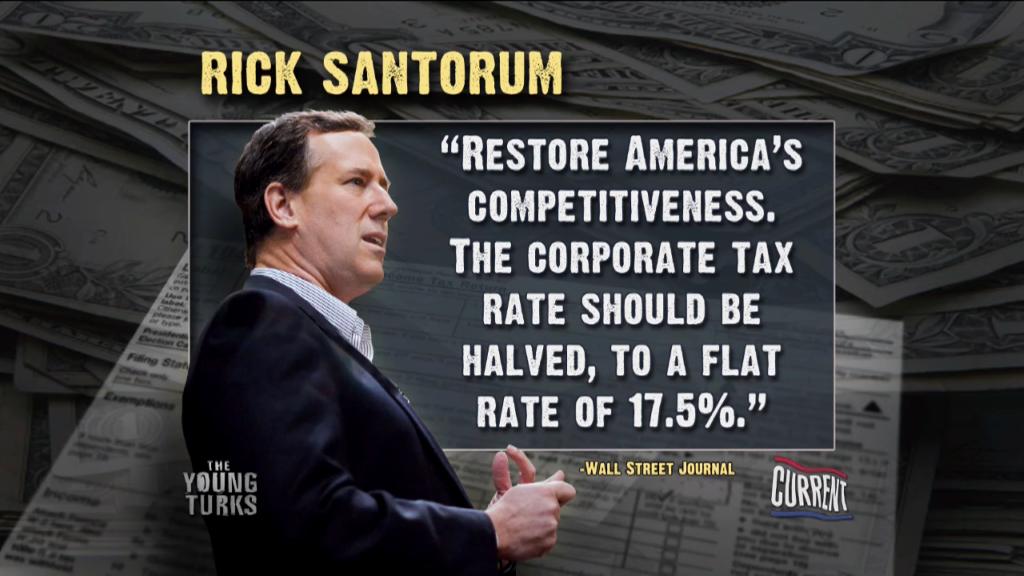
Rick Santorum proposes cutting corporate tax rate in halfCenk Uygur:  We always hear from Republicans that taxes are too high, especially when it comes to corporations because those are the guys who fund their campaigns.  In fact, Rick Santorum just wrote an op-ed saying in order to “Restore America’s competitiveness, the corporate tax rate should be halved, to a flat rate of 17.5%.”  Brilliant:  cut corporate taxes even more, as if corporations in America were not getting enough of a big enough break.  Absurd.

Warren Buffett refuting the myth about lowering corporate taxes for American competitivenessBut there is one guy who is taking them on:  it’s Warren Buffett.  Let us hear him out.

Warren Buffett:  But it is a myth that the American corporations are paying 35% or anything like it.  Corporate taxes are not strangling American competitiveness.

Corporate taxes are at a 40 year lowCenk Uygur:  Is he right?  Absolutely.  Look at this number.  Do you know what the effective corporate tax rate is in America?  12.1%.  It’s a 40 year low.  12.1%, not 35%.  The Republicans have problems with numbers.

Let’s go to the next set of numbers.  I will talk slowly so you can understand, GOP. 

Corporate taxes by industry 2008 to 2010Now here is the effective tax rate for all of these different industries:

Industrial Machinery:  13.5%

IT (Technology field):  2.5%

Utility:  3.7%

Where is the 35%?  I don’t see it anywhere!

Financial Industry:  15.5%

Where the hell is 35%?  Nobody is paying it.

Top 30 most profitable companies had a negative tax rateOkay if you think that is bad, look at this.  Some of the top thirty (30) companies in between 2008 and 2010 had a negative tax rate. 

Do you know what that means?  We are giving them money.  They are not giving us money in taxes; we are giving it back to them.  It is insanity.

How about GE?  Jeffrey Immelt is now the head of the Job’s Council for President Obama.  They must be giving back to the community, etc.; they are such good citizens.  Let’s check out the numbers.

GE paid no taxes in 2010 but received money backHow much did they pay in taxes in 2010?  Zero.  In fact, they got so much money back in taxes so that it is in effect a 64% negative tax rate for them.  Overall between 2002 and 2011 they paid a 2.3% tax rate.  Over a decade they paid 2.3% on average.  Where the hell is 35%?

Nobody is paying 35%.  And they get rewarded by going on the President’s Job’s Council, like they are some great guys or something.

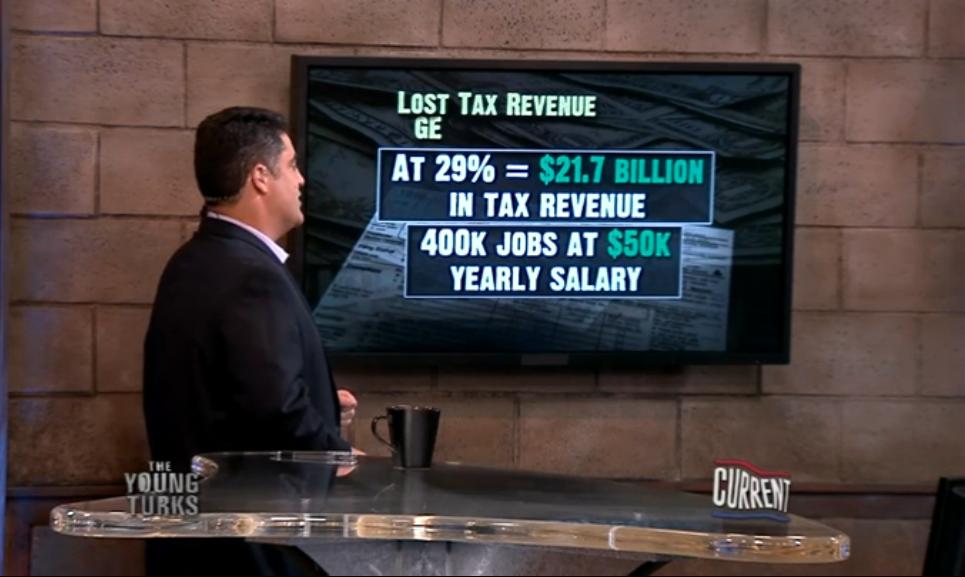
Lost tax revenue from GENow let me give you some more numbers on GE.  If they just paid the 29% tax rate, that would have brought in an additional $21.7 billion in tax revenue.   That could have created 400,000 jobs at $50,000 a year salary.  This is what happens when corporations don’t pay their taxes.  And at the end of all this, they are still bitching that they did not get enough of a tax break.  Are you kidding me?

Now here comes big loud-mouth Chris Christie and McConnell to complain that they are still paying too much, and complaining about Buffett.

Chris Christie:  He should just write a check and shut up.  Really, and just contribute, okay?   The fact of the matter is that I am tired of hearing about it.  If he wants to give the government more money, he’s got the ability to write a check:  go ahead and write it.

Mitch McConnell:  With regard to his tax rate, if he is feeling guilty about it, I think he should send in a check. 

Cenk Uygur:  Oh, ho, ho, ho, they got him.  Why don’t you just write in a check, ha, ha, ha?  Listen.  That’s not how it works.  And Warren Buffett, when he was on CNBC said, you don’t take away trillions in deficits by making it voluntary.  That’s not how it works. 

And he said, if that’s how it works, for every Republican that pays extra voluntary taxes, I’ll match it.  And he said for Mitch McConnell, I’ll go three to one.  Every dollar he pays in taxes voluntarily, I’ll pay three times as much.  Do you know how much Mitch McConnell has paid extra?  Zero.  Not at all, because they don’t mean a word of it. 

But you must think if they are paying such low taxes, their profits must be in trouble, there was a recession, right?  Sixty year high for profits. 

Corporate profits at 60 year highAre you ready for this number?  In the third quarter of 2011 alone, $1.97 trillion.  They made that in a quarter of a year. 

But when it comes to their paying their taxes, are they going to pay it? 

They are not going to pay it. 

Sources of Federal Tax Revenue from 1950 to 2009In fact, look at the chart from 1950 to 2009.  I think this is a killer chart.  This is the corporate taxes as a percentage of all of our taxes.  It nosedives.  It goes from around 30% to around 6% to 5%.  And then do you see the graph going way up?  The yellow number there?  That’s the percentage of taxes paid by us through the payroll tax.  Somebody’s got to pay the tax.  So when corporations don’t pay their taxes, who does?  You do!  The percentage of taxes that you pay through the payroll tax goes way up! 

Look, this is about justice.  The corporations are not paying too much; they are paying too little.  The effective rate is 12.1%.  So when they don’t pay their taxes, we have to pay more.  It ain’t right.  Warren Buffett is 100% right.  And Chris Christie should shut his mouth.

Transcription by

The Barefoot Accountant

Accountants CPA Hartford, Connecticut, LLC

Posted in Accountants CPA Hartford, Articles | Tagged , , , , , , , , , , , , , , , , , , , , | 2 Comments