Senator Bernie Sanders on This Week With George Stephanopoulos – ABC News

The Barefoot Accountant at Accountants CPA Hartford, Connecticut, LLC presents the transcript and video of an interview of Senator Bernie Sanders, who appeared on This Week With George Stephanopoulos – ABC News on May 3, 2015.  The transcript may contain errors so please watch and listen to the video.

Newly declared presidential candidate Sen. Bernie Sanders said today he hopes to lead a “political revolution” for working families and against money in politics in his bid for the White House.

“I think I’m the only candidate who’s prepared to take on the billionaire class,” Sanders, I-Vt., told ABC’s George Stephanopoulos on “This Week.” “We need a political revolution in this country involving millions of people who are prepared to stand up and say, enough is enough, and I want to help lead that effort.”

Sanders, who will run in the Democratic primary against Hillary Clinton, told ABC’s Jonathan Karl earlier this week the millions of dollars flowing into the Clinton Foundation poses a “very serious problem.”

“It’s not just Hillary. It’s the Koch Brothers. It is Sheldon Adelson,” he said, referring to billionaire backers of conservative causes and candidates. “Can somebody who is not a billionaire who stands for working families actually win an election?”

Sanders could challenge Clinton from her left. He opposed the Iraq War, which Clinton supported in the Senate, and is against Trans-Pacific Partnership trade agreement, which the Obama administration is trying to get through Congress.

Clinton fully supported TPP as secretary of state but has raised reservations about it since announcing her presidential bid.

“Hillary Clinton has been part of the political class for many, many years,” Sanders said. “I respect her and I like her, but I think what the American people are saying, George, is … maybe it’s time for a real political shakeup in this country.”

He has raised more than $1.5 million since announcing his campaign on Thursday, but has pledged not to have a Super PAC that could accept unlimited contributions.

A self-described socialist who won his first election to become mayor of Burlington, Vermont, by just 10 votes, Sanders has a message for his doubters.

“Very few people thought that I would beat an incumbent Republican to become United States congressman from Vermont by 16 points,” Sanders said. “And people weren’t so sure I could beat the richest person in Vermont to become a United States senator.

“Don’t underestimate me,” he added.

STEPHANOPOULOS: And Senator Bernie Sanders joins us now. Welcome to “This Week.” Why are you the best choice for president of the United States?

SANDERS: Because for the last 30 years, I’ve been standing up for the working families of this country, and I think I’m the only candidate who’s prepared to take on the billionaire class, which now controls our economy, and increasingly controls the political life of this country. We need a political revolution in this country involving millions of people who are prepared to stand up and say, enough is enough, and I want to help lead that effort.

STEPHANOPOULOS: So does that mean that Hillary Clinton is part of the billionaire class?

SANDERS: It means that Hillary Clinton has been part of the political establishment for many, many years. I have known Hillary for some 25 years. I respect her and I like her, but I think what the American people are saying, George, is that at a time when 99 percent of all new income is going to the top 1 percent, and when the top 0.1 percent owns almost as much wealth as the bottom 90 percent, maybe it’s time for a real political shakeup in this country and go beyond establishment politics.

STEPHANOPOULOS: You are asking for a lot of shakeup. Is it really possible for someone who calls himself a socialist to be elected president of the United States?

SANDERS: Well, so long as we know what democratic socialism is. And if we know that in countries, in Scandinavia, like Denmark, Norway, Sweden, they are very democratic countries, obviously. The voter turnout is a lot higher than it is in the United States. In those countries, health care is the right of all people. And in those countries, college education, graduate school is free. In those countries, retirement benefits, childcare are stronger than in the United States of America. And in those countries, by and large, government works for ordinary people and the middle class, rather than, as is the case right now in our country, for the billionaire class.

STEPHANOPOULOS: I can hear the Republican attack ad right now. He wants American to look more like Scandinavia.

SANDERS: That’s right. That’s right. And what’s wrong with that? What’s wrong when you have more income and wealth equality? What’s wrong when they have a stronger middle class in many ways than we do, higher minimum wage than we do, and they are stronger on the environment than we do? Look, the fact of the matter is, we do a lot in our country, which is good, but we can learn from other countries. We have, George, the highest rate of childhood poverty of any major country on earth, at the same time as we are seeing a proliferation of millionaires and billionaires. Frankly, I don’t think that is sustainable. I don’t think that’s what America is about.

[…]SANDERS: What I am saying is that I get very frightened about the future of American democracy when this become a battle between billionaires.

I believe in one person, one vote; I believe we need a constitutional amendment to overturn Citizens United. And let me say this: on our first day, first day that we were out, we asked people to get involved in our campaign, 100,000 people signed up; 35,000 people made donations to berniesanders.com and we raised on that first day $1.5 million — and you know what the average contribution was?

STEPHANOPOULOS: What was it?

SANDERS: $43.

STEPHANOPOULOS: And you got that berniesanders.com back out there again. We’ll see what comes —

SANDERS: You want to repeat that —

(LAUGHTER)

STEPHANOPOULOS: Let’s talk about a Sanders administration. What would it look like? You voted against both Obama Treasury Secretary nominees, both Jack Lew and Tim Geithner.

Name a couple people you would consider for Treasury Secretary.

SANDERS: Robert Reich is somebody who I have — who was, in fact, the Secretary of Labor — you know Robert. I think he has been a strong progressive and understands that what we need are economic policies that benefit working families, not the big money.

You’re right. I voted against these guys and I led the effort when I was in the House against the deregulation of Wall Street. I knew then that would be a disaster and it turned out unfortunately that I was right.

[…]

STEPHANOPOULOS: Let me ask you, the presidential campaigns are famously actually the souls of a candidate, every part of your life is going to get scrutinized. So let’s do a shortcut.

What’s the most surprising thing people are going to learn about Bernie Sanders over the course of the next year?

SANDERS: I think Bernie Sanders is the proud grandfather of seven beautiful kids, grandchildren, four kids, married for almost 30 years. I grew up in a low-income, low middle class income family in Brooklyn, New York, 3.5-room rent controlled apartment. And growing up without a whole lot of money, George, that has been, I think, the most significant educational factor, if you like, in my life. I know what it’s like to live in a family without a lot of money.

STEPHANOPOULOS: Most people don’t believe you can actually become President of the United States.

Are you worried at all that your race might weaken Hillary Clinton without helping yourself?

SANDERS: Well, let me just say this about my political career. I think few would argue that it is the most unusual political career in the United States Senate. Nobody thought that I would be elected mayor of Burlington, Vermont. Very few people thought that I would beat an incumbent Republican to become United States congressman from Vermont by 16 points. And people weren’t so sure I could beat the richest person in Vermont to become a United States senator.

So I would say don’t underestimate me.

STEPHANOPOULOS: Bernie Sanders, thanks very much.

SANDERS: Thank you, George.

And senator Bernie sanders joins us. Welcome to this week. Why are you the best choice for president of the United States.

For the last 30 years I have been standing up for the working families of this country and I think I’m the only candidate prepared to take on the billionaire class which controls our economy and the political life of this country. We need a political revolution in this country involving millions of people prepared to stand up and say enough is enough. And I want to help lead that effort.

Does that mean Hillary Clinton is part of the billionaire class?

It means that Hillary Clinton has been part of the political establishment for many, many years. I have known Hillary for 25 years. I respect her and I like her. But I think what the American people are saying, George, is that at a time when 99% of all new income is going to the top 1% and when the top 1/10 of 1% owns almost as much warmth as the bottom 90% maybe it’s time for political shakeup in this country and go beyond establishment politics.

You’re asking for a lot of shakeup. Is it possible for someone who calls themselves a socialist to be elected president of the United States?

So long as we know what democratic socialism is. If we know that in countries like Denmark and Norway and Sweden, they are very democratic countries. Their vote of turnout is higher. Health care is the right of all people. College education and graduate school is free. In those countries retirement benefits are stronger than the United States of America. And those countries, government works for ordinary people in the middle class rather than as is the case in our country for the billionaire.

I can hear the republican attack ad right now. He wants America to look more like Scandinavia.

That’s right. That’s right. What’s wrong with that? What’s wrong when you have more income and equalty and a stronger middle class, a higher minimum wage than we do and stronger on the environment than we do? We do a lot in our country which is good but we can learn from other countries. We have the highest rate of childhood poverty of any country on Earth at the same time as we’re seeing a proliferation of millionaires and billionaires. I don’t think that’s what America is about.

You’re the longest serving independent in congress. You said you would remain an independent but prepared to file as a democratic?

In my heart I am an independent and have been for 30 years. I’m seeking the democratic party nomination for president of the United States and obviously I’m going to follow all of the rules and regulations to get on the ballad as a democrat.

If you lose will you support the democratic nominee? Yes. I have in the past. Not going to run as an independent. No. I have been clear about that.

Which ideas? What are the biggest differences between you and Hillary Clinton?

It has a lot to do with our records. I think at a time when we have seen trillions of dollars shift from the middle class to the top 1/10 of 1% we have got to say very frankly that the wealthiest people of this country and largest corporations are going to have to start paying their fair share of taxes. Profitable corporations can’t stash their money in the Cayman Islands and avoid taxes. That’s my view. In terms of climate change I believe this is the great global environmental crisis of our time. I think we need bold leadership. I have been leading the effort against the Keystone Pipeline. In terms of trade, I believe the trade agreements we have had from way back, Normal trade relations with China have been a disaster. I voted against them. I’m helping to lead the effort against the partnership so that we do not continue to see shutdowns of factories in America and the loss of paying jobs.

Hillary Clinton hasn’t taken a final stand on that.

That’s my understanding.

You told my colleague that you have concerns about the money raised by the Clinton foundation. What are the concerns?

It’s not just the Clinton foundation. Here are my concerns. It should be the concern of every American. And this is in a sense what my campaign is about. Can somebody who is not a billionaire who stands for working families actually win an election in which billionaire supporting hundreds of billions of dollars into the election? It’s not just Hillary. It is the Koch brothers. Sheldon Adelson.

You’re lumping her in with them?

What I am saying is that I get very frightened about the future of American democracy when this becomes a battle of billionaires. I believe we need a Constitutional amendment. To overturn Citizens United. On our first day that we were out, we asked people to get involved in our campaign, 100,000 people signed up. 35,000 made donations to berniesanders.com and we raised on that first day $1.5 million. You know what the average contribution was?

What was it?

$43.

You got that berniesanders.com out there again. You want to repeat that.

Let’s talk about a Sanders administration. What would it look like? You voted against both Jack Lew and Tim Geithner. Name a couple people you would consider for Treasury Secretary.

Robert Reich. He has been a strong Progressive and understands we need economic policies that benefit working families, not the big money. You’re right. I voted against these guys and I led the effort when I was in the House against the deregulation of Wall Street. I knew then that would be a disaster and turned out that I was right.

How about secretary of defense?

Well, little bit premature.

Not ready to do that yet. Let me ask you. The presidential campaigns are famously x-ray of souls of candidates. Every part of your life is scrutinized. Let’s do a shortcut. What’s the most surprising thing people are going to learn about Bernie sanders over the course of the next year?

I think Bernie sanders is the proud grandfather of seven beautiful kids. Grandchildren. Four kids. Married for almost 30 years. I grew up in a low middle class income family in Brooklyn, new York. 3 1/2 room apartment. Growing up with not a whole lot of money, George, that has been I think the most significant educational factor if you like in my life. I know what that’s like.

Most people believe you can’t actually become President of the United States. Are you worried that your race might weaken Hillary Clinton without helping yourself?

Let me say this about my political career. I think few would argue it is the most unusual political career in the United States Senate. Nobody thought that I would be elected mayor of Burlington, Vermont. Very few thought I would beat a republican to become a congressman by 16 points and people weren’t sure I could beat the richest person in Vermont. I would say don’t underestimate me.

Thanks.

Thanks.

Posted in Accountants CPA Hartford, Articles | Tagged , , , , , , , , , , , , | Leave a comment

Ed Shultz interviews Bernie Sanders on The Ed Show April 30 2015

The Barefoot Accountant at Accountants CPA Hartford, Connecticut, LLC presents the transcript and video of an interview of Senator Bernie Sanders, who appeared on The Ed Show on April 30, 2015.  The transcript may contain errors so please watch and listen to the video.

Show: THE ED SHOW
Date: April 30, 2015
Guest: Bernie Sanders, Paul Henderson

ED SCHULTZ, “THE ED SHOW” HOST: Good evening Americans and welcome to the
Ed Show, live from Washington, D.C.

Let`s get to work.

(BEGIN VIDEO CLIP)

SCHULTZ: Tonight.

SEN. BERNIE SANDERS, (I) VERMONT: I will be running in a sense as
Independent-Democrat.

We`re in this race to win.

SCHULTZ: Plus.

UNIDENTIFIED FEMALE: The timeline, and the evidence, and the information
that we have developed in the story just not match.

UNIDENTIFIED MALE: We know, what happened. They assume they know what
happened. We don`t need a report.

UNIDENTIFIED MALE: Just sick and tired, sick and tired of the foolishness.

(END VIDEO CLIP)

SCHULTZ: Good to have you with us tonight, folks. Thanks for watching.
It`s an important day here on the Ed Show, a gentlemen who has appear in
this program quite often joins us tonight, backing up a big announcement.

Earlier today, Vermont Senator Bernie Sanders officially announced that he
will run as a Democrat for the president of the United States. This makes
Senator Sanders that first Democratic challenger to Hillary Clinton.

Many will view this as a good day for democracy and the backdrop of all of
this today is activism in numerous cities across America.

You`re looking live at a March in Philadelphia today, after marches and
protests in New York City last night. This seems to have taken on a life
of its own. There will be marches later on today in Baltimore but this is
the scene in Philadelphia. And we start our interview tonight with Senator
Sanders on this topic.

Senator, good to have you with us tonight.

SANDERS: Great to be with you.

SCHULTZ: Congratulations on this announcement. Certainly, it is a big
challenge for you. But I want to go right to today`s news, Senator.

You are now president of the United States. You see what`s unfolding on
American streets, what`s the problem as you see it? What`s the solution?

SANDERS: Will the problem is that, for many years, police brutality and
the killing of innocent people has not been (inaudible), that`s a fact.

The good news, Ed, is that the American people, not just the African-
American community are saying enough is enough. You can`t hold people in
custody and suddenly find out that they are dead. You can`t shoot people
in the back, you know, in South Carolina. The conservative southern state,
a police officer was charge with murder.

I`m a former mayor. I know that being a cop is not an easy job. But when
police officers misbehave, they`ve got to be held accountable.

The other good news is that, all over this country when people are
beginning to standup and say “enough is enough” change is taking about.
You ask me what I would do as president. Number one, we would fight hard
for police reform, for body cameras, for the training that police officers
need to know how to treat people who in captivity with respect.

But the underlying issue in terms of Freddie Gray`s community as I
understand that the (inaudible) unemployment rate there is…

SCHULTZ: It`s extremely high. It`s almost they`re there and they`ve lost
so many manufacturing jobs over the last 15 years, the city, the community
is not had felt the way or found the way to deal with it.

SANDERS: And, you know, you can have every police officer in America being
a Harvard Law School Graduate and you`re not going to address this issue
unless we get people some hope, unless we give people some opportunity,
that means jobs, that means education. You can`t turn your back on the
collective parts of America.

SCHULTZ: So what would you do if you`re president when it comes to
revitalizing communities like this that are having socioeconomic problems?

SANDERS: Well, I`ll tell you what we`ve already introduce legislation for
a spot. We would invest a trillion dollars in our infrastructure putting
13 million (inaudible), 13 million new jobs rebuilding a roads and bridges
or water systems, a wastewater flux (ph), that would create a whole lot of
jobs.

I introduce with Congressman John Conyers of Michigan, $5.5 billion job
training and job creating program for young people. You thought employment
in America is 17 percent. African-American youth employment is totally off
the chart. We got to put young people to work, we`ve got to give them an
education rather than putting them in jail.

SCHULTZ: What did you think of the riots the other night? I want to know,
I mean, has the social structure gotten to the point where this is the only
outlet these people had at that particular time. I heard a lot of official
say, “Well, this is in Baltimore”. You know, they`re peaceful for a week
until the camera showed up. But it did happen, the riots did happen and it
was in Baltimore.

SANDERS: And so, what`s the solution, what I think? I think there is a
muscles amount of anger and discontent. And I think it has more than just
what happened to Freddie Gray.

I think it is people are saying, how come we are living in the richest
country in the history of the world, our kids can`t go to college, we don`t
have trial care for our kids, we don`t have any jobs. I think that`s
significantly what it`s about.

SCHULTZ: All right. Senator, why are you running? Why are you doing this?
I`ll tell you why I`m doing it. And I feel, you know, it`s my first day
out there and I`m feeling good about it.

This country today, Ed, faces more crisis than we have faced since the
Great Depression, and then to throw in climate change, which the scientist
that telling us is the major global crisis that we faced is probably worst
than (ph) we were in the Great Depression.

I don`t see people talking about this issue, I don`t see politicians
working on this issue, and I think it`s time that we address it.

And getting back to your point, the only way that change takes place in my
view is when millions of people standup and say “enough is enough”. And
it`s not just with police brutality.

Enough is enough when the great middle-class of this country is
disappearing, does that happen? That we have more technology and increase
productivity and people are working longer hours for low wages and we have
more people living in poverty than the most anytime in the history of
America. How does that happen?

How does that happen that 99 percent of new income in this country goes to
the top one percent, how does that happen that the top, one-tenth of one
percent owns almost as much wealth as the bottom 90 percent.

These are the central issues facing this country. And then on top of that,
as a result of this disaster, Citizens United, Supreme Court decision. We
are in a moment where billionaires are about to buy the United States
government and undermine American democracy.

SCHULTZ: So why would you be a better president, a better nominee than
Hillary Clinton?

SANDERS: You know, I`m going to let Hillary Clinton speak for herself.

SCHULTZ: Well, let`s talk about how she handle the big issue…

SANDERS: All right.

SCHULTZ: … and that is trade. Today, her communications team released
an exert from here book saying that she stands with Elizabeth Warren with
it comes to trade and did an exert. I think the American people are
looking more for a direct answer which you have been very direct on this,
you are against trade promotional authority and you are against the TPP.

SANDERS: The TPA would led to a bad trade deal look, Ed…

SCHULTZ: So where do you stand on this and right after President Obama,
after there midterms took place and the Republicans took over the Senate.
This is the first thing that Mitch McConnell talked about the day after
press conference saying that there`s areas that they can work on with the
president, one of them is trade. That was supposed to be a slam dunk.
We`re not almost at May 1st, and they don`t have the votes in the house.
Does that give you an confidence that…

SANDERS: Absolutely.

SCHULTZ: … the rest would (inaudible) can help you.

SANDERS: I`ve been going around with country. I`ve been talking about the
trade issue. I don`t have to talk about the people increasingly (ph) know
about it. And they are saying, “Look, NAFTA was a disaster, CAFTA was a
disaster, permanent and normal trade relations that China was a disaster,
why do we want to continue down a path?” We have the previous agreements
have lead to the laws of million of these paying jobs. So they asking me,
should the American work be force to compete against somebody in Vietnam
who has a minimum wage $0.56 an hour, y what the answer is? No.

We`ve got a demand that corporate America is now reinvesting in the United
States of America, not trying to — it is a huge issue. I voted against
all of these agreements. I will help the opposition against the TPP.

SCHULTZ: What about the money? Can you raise enough money to run a
competitive campaign?

SANDERS: One of the hesitant is, I had about going forward with just that.
Clearly, I`m not going to have anyway near the same amount of money as the
other candidates who are going to be probably raising over a billion
dollars. But you know what? I think that we can raise a lot of small
donations today, we open up our website. We announce our candidacy,
berniesanders.com. I believe in the first few hours, we`ve raise already
$0.5 million.

So I think there is a lot of potential out there from people to say,
“Bernie, I can give you a million dollars. I can give you a thousands
dollars. I can give you $50. I think we can raise the money we need to
run a strong campaign.

SCHULTZ: So to run a campaign, so there`s an admission here that you
certainly won`t have the television presence that Hillary Clinton`s
campaign will have. And I have to keep to bringing up Hillary Clinton
because she is the only one on the race beside you. And it might turn out
to be that just it. So what do you think it takes to run a competitive
campaign to organize?

SANDERS: I`ll tell you what it takes. What it requires is and what I have
always done in Vermont, is run strong grassroots campaign. You know, last
campaign that I run, I didn`t put a nickel, not a nickel on TV ads. We put
all of our money into grassroots organization. I got 71 percent of the
vote.

So I think what we have to do is go out there, get good organizers, build a
strong volunteer base, work with the labor movement, work with the
environment community, work with the women`s community, and mobilize people
in all across this country to standup and fight back to the billionaire
brother (ph).

SCHULTZ: Do you expect the support of labor?

SANDERS: I think we will have certainly some labor support, absolutely.

SCHULTZ: Some.

SANDERS: The thought to say at this point. I`ve talk to some of the
unions, some of them are sympathetic, some of them may not be. We will
say…

SCHULTZ: But they`re all against the TPP.

SANDERS: Without exception.

SCHULTZ: All of them.

SANDERS: Every single union.

SCHULTZ: This is their issue.

SANDERS: Rich Trumka, the President of AFL-CIO recently reported and said
again, this is a key issue for the AFL-CIO.

SCHULTZ: How would President Bernie Sanders be different from President
Obama?

SANDERS: I`ll tell you. First of all, I have lot of respect for President
Obama. He is a friend. I have disagreed with him on tax policy, I was on
the floor of the Senate few years ago, for 8.5 hours arguing that he should
not continue some of Bush`s tax rates for the rich. And obviously, we have
strong disagreement on the TPP.

Well, I think the President has made his biggest mistake is that, after his
historic and brilliant 2008 presidential campaign in which he rally the
American people, for what young people into the political process. What he
did after he was elected as kind to say, “Hey, thanks a lot. I appreciate
it, you`re gone. And now I`m going to sit down and argue, and try to
negotiate with John Boehner or with John Boehner. I think that was a
terrible mistake because here`s the truth, Ed, and I`m the only candidate
maybe will have to say this.

No president, not the smartest, best human being in the world can do it
alone. You cannot take on this, the power that is in Washington, to
billionaires and lobbyist, the military industrial complex, all of this
money and power, you can`t do it.

You need a mass movement of American who are looking in congress and we say
directly. If you don`t make college education affordable, you`re out in
here, because we know what`s going on. If you don`t end this huge tax
breaks for the rich, you are out of here.

So what we have got to do, well I call it a political revolution is raise
political consciousness in this country, make people aware of what`s going
in Washington, the importance of politics, get them involved in the
political process and have them standup to the big money interest of today,
have so much power.

SCHULTZ: If you`re president of the United States, what would be your
policy in dealing with ISIS?

SANDERS: This is what I think. ISIS is obviously barbaric organization
has to be defeated. That I will do everything that I can to prevent the
United States getting involve in a another ground war in that country, two
wars in enough (inaudible).

SCHULTZ: Can they be defeated without a ground war?

SANDERS: No. But I think the people who have to wage (ph) the ground war
are not troops from United States of America. You have Saudi Arabia
seating right in that area which has nobody knows this. The third largest
military budget in the world, third largest. You have other very wealthy
and powerful countries, seating in that region. They have got to wage (ph)
the fight for the soul of Islam. We should be supportive along with other
European countries, give them support. I support airstrikes, special
missions. But at the end of the day, it`s going to be, have to be the
Muslim nation themselves who are leading the fight with our support.

SCHULTZ: So say you support airstrikes, what about the use of drone in the
way they`ve been handled in the Obama administration, will you continue
that?

SANDERS: Well, I don`t think it`s a yes or no. Clearly, it has been
counter productive when we kill innocent people including Americans. But
they are one tool that I think is in the arsenal. But clearly, in many
instances, they`ve backfired on us.

SCHULTZ: So drone strikes would continue then if you are president?

SANDERS: In a very selective way.

SCHULTZ: Would the policy change, would there be a different bedding
process on…

SANDERS: Yes.

SCHULTZ: … on how to get to that?

SANDERS: Look, we have had some successful drones. We have had a lot of
failures with drone. I think we have to reanalyze what we are doing there.

SCHULTZ: Senator Sanders, you have been really the fighter out front and
the leader when it comes to the conversation of income inequality in
America.

Wall Street, would be in favor of reinstating or advocating for their
reimplementation of Glass-Steagall, was that the beginning of our problems,
the breakup of the commercial and investment banks.

SANDERS: Well, Ed, if you want to go to YouTube, you could see a dialogs
that I had when I was in the house with Alan Greenspan, and taking him on.
He was talking about all of the wonderful benefits of the deregulation of
Wall Street. You know, I told him he was dead wrong then and he was.

I was in — he is a member of the house, one of the leaders that opposition
of this deregulation. I think it was a tragic mistake but this is what
I`ll you. I would go further than just reinstating Glass-Steagall.

I think what we have got to appreciate is when you have six financial
institutes that have assets equivalent to about 60 percent of the GDP of
America, you know what? Let`s be honest. You can`t regulate that.

SCHULTZ: You breakup the banks.

SANDERS: Absolutely. Absolutely. They are — if they`re too big to fail,
they are too big to exist. They are issuing 50 percent of the mortgages
and two-thirds of the credit cards in this country.

If Teddy Roosevelt were the president, what do you think he would do?

SCHULTZ: Well, he probably do that.

SANDERS: That`s right.

SCHULTZ: Senator Sanders, stay with us, we`ve got more to come.

Follow us on Facebook and watch my Facebook feature “Give me a minute” and
of course, you can get my video podcast at wegoted.com.

Later this hour, we`ll have updates from Baltimore as new details about
Freddie Gray`s case emerge.

Stay tune, more with Senator Sanders on the Ed Show.

(COMMERCIAL BREAK)

SCHULTZ: We are closely monitoring protest and marches in Baltimore and in
Philadelphia tonight. We`ll bring you the latest, coming up. But first
more with Senator Bernie Sanders, what`s he`s background, what is his
answers been like through the years, and what his focus.

That`s all coming up, stay with us here on the Ed Show.

(COMMERCIAL BREAK)

SCHULTZ: Welcome back to the Ed Show.

He is a public servant who have not has not had a hard time throughout his
career, telling people what he thinks and what he believes in.

(BEGIN VIDEO CLIP)

SANDERS: In 1981, I was persuaded by some friends to run for Mayor of
Burlington, the largest city in our state. Nobody but nobody so that we
had a chance to win, we do.

UNIDENTIFIED FEMALE: Today, is talking about Senator Bernie Sanders, but
back in 1981, Sanders won his first election by just 10 votes.

SANDERS: I would like to see somebody who speaks for the underdog, for the
people who don`t have this in healthcare benefits. So I would like to see
a candidate who has the guts to opposition that America could be a land for
all people, not just the land control by the super rich.

UNIDENTIFIED FEMALE: Throughout the years, Bernie Sanders message has been
consistent.

SANDERS: Go Alabama, go Oklahoma, stand on street corner and say, “Do you
believe that we should cut social security, Medicare and Medicaid and give
tax breaks to billionaires”. And they will laugh you.

UNIDENTIFIED FEMALE: From the start, Sanders made headlines as
unapologetic socialist and a champion of progressive causes.

SANDERS: So I think the reason that we went in and continue to win is
that, increasingly people are frustrated and angry about a two party system
which is dominated by big money and which does not pay attention to needs
of working people or elderly people, or poor people.

UNIDENTIFIED FEMALE: Bernie Sanders moved up to the U.S. House of
Representatives in 1991, long before it was a hot button issue, Sanders
addressed income inequality in one of this first floor speeches.

SANDERS: At the very least, we must demand that those individuals, the
upper income people have seen their real income (inaudible) during the
1980s, start paying their fair share of taxes.

UNIDENTIFIED FEMALE: After 16 years, serving as Vermont congressman,
Bernie made a run for the Senate and won.

SANDERS: The time is long overdue for the United States Senate and House
to start representing the working families Americas and not the rich and
the powerful.

UNIDENTIFIED FEMALE: In 2010, Sanders` eight-hour filibuster against
extending the Bush era tax cuts helped him storm the national stage.

SANDERS: That we don`t need to drive up the national debt by giving tax
breaks to millionaires and billionaires.

UNIDENTIFIED FEMALE: Now, Sanders is running for president. In the face
of big money and big name brands, there is no doubt Bernie Sanders faces an
uphill battle. But in progressive circles, Sanders is celebrated as the
underdog. He continues to find success by following a very simple formula.

SANDERS: I think if talk common sense to the people and you say the
government is suppose to represent the needs of those people who today are
not getting a fair share (ph), you know what? They`ll vote for you.

(END VIDEO CLIP)

SCHULTZ: From the Mayor of Burlington, Vermont to the United States
Senate, Bernie Sanders is taking a very interesting and clear path to this
very day. The Senator joins me again this evening here on the Ed Show.

Senator, we never talked about you that much. We`re always talking about
issues. Why did you get into politics? Why are you doing this for a
living?

SANDERS: You know, Ed, I grew up in a lower middle class family. My dad
came to this country from Poland without a nickel on his pocket and need to
made much money. We lived in a three and a half room rent control
(inaudible) in Brooklyn before I moved to Vermont.

And it was very clear to me as a kid the impact of money had on my family
distress, the arguments that my parents had. You know, see another kids
having benefits of certain other kids didn`t have.

And so, from my earliest years, I understood the importance of income
security as a need for people to have at least the minimal standard of
living to enjoy the kind of life that they are entitled to. So that`s kind
of what`s motivated me.

SCHULTZ: That has motivated you throughout the years?

SANDERS: I`ve never forgotten those experiences.

SCHULTZ: It`s interesting, some of the sound bites that you had back in
yesteryear match to your philosophy today, is it always been that way?

SANDERS: Yeah. The people of Vermont was like, “Oh, God, not again. He`s
saying the same thing for 30 years”. But guess what…

SCHULTZ: But your focus on issues is the same as…

SANDERS: But the other thing is and I think the report indicated, more and
more people are catching that (ph). I was talking about these issues 20
years ago before it was popular. But this issue of income and wealth
inequality, Ed, it`s not only in economic issue or a political issue, it is
a moral issue. It is a moral issue.

And by the way, you know the guy who speaks about that most forcefully in
this world, it`s the Pope, Pope Francis.

He raises, this is a moral issue. All we content to have the highest rate
in this country of trials and poverty and at the same time have a
proliferation of millionaires and billionaires. That is a moral issue.

And I think the American people saying no that`s not who we are as a
people.

SCHULTZ: Now, when you go to Iowa and you say that, what`s your reaction?
What`s the reaction of the folks?

SANDERS: I got to tell you, you know, (inaudible) serve you going to —
and people who come out to our meetings.

SCHULTZ: They get it…

SANDERS: … but the response has been really extraordinary. And not only
in Iowa, all over this country. People are saying enough is enough. Think
about all the things that we can do as a nation. Why can`t we guarantee
healthcare to all people in every other major country does it?

In Germany, many other countries, college tuition is free. Why isn`t free
in America? Why do we have the highest rate of childhood poverty when
other countries have rates much lower than we have? Why don`t we have pay
equity for women workers? Why aren`t we leading the world in transforming
our energy system in terms of climate change?

We can do that. Are we dumb? Are we lazy? Not the case.

SCHULTZ: I want to focus on college.

SANDERS: Go.

SCHULTZ: It is expensive. It`s exuberant at this point. Students get
out, strap with debt. The American dream escapes them early on if they
ever going to own their own home and have any kind of financial
independence. What would you do differently?

SANDERS: I`ll tell you what I would do exactly and we`re going to
introduce legislation to do it.

Ed, it will cost us about $70 billion a year of federal money or money in
general, to provide free tuition in every public college and university in
American. $70 billion a year.

The Republicans want to give $269 billion and tax rates to the richest,
5000 families by eliminating the state tax. We lose $110 billion every
year because corporations stash their money in the Cayman Islands and pay
nothing in federal taxes.

I happened to believe if we`re going to be competitive in the global
economy, we need the best educated workforce, we need to encourage kids to
go to college, graduate school, regardless of their income. We can come up
with that money and that`s what I would be fighting for.

SCHULTZ: What`s on your schedule on the next week?

SANDERS: We`re going to be speaking to the AFL-CIO on Saturday in New
Hampshire. We have a branch in Manchester, New Hampshire. On Sunday,
we`ll be doing a national TV show. We`re going to be working very hard on
the United States Senate. I`m the ranking member on the budget committee.

This Republican budget is beyond belief. Tax breaks to billionaires, cuts
for working families throwing 27 million people off the health insurance.
We`re going to be raising hell about that issue as well.

SCHULTZ: All right. Senator Bernie Sanders, obviously, will visit again.
Good to have you with us tonight. Thanks so much.
<
SANDERS: Thanks. Great to be with you.

Posted in Accountants CPA Hartford, Articles | Tagged , , , , , , , , , , | Leave a comment

Clinton Cash – do you trust Bill and Hillary Clinton in positions of power

The Barefoot Accountant at Accountants CPA Hartford, Connecticut, LLC presents the transcript and video of a segment of Meet the Press on April 26, 2015.  The transcript may contain errors so please watch and listen to the video.

CHUCK TODD:

Welcome back. We’re two weeks into the Hillary Clinton presidential campaign. And Republicans and some journalists have been working themselves into a frenzy over a new book on the Clintons that’s about to be released. It’s called Clinton Cash. It’s by Peter Schweizer. Alleges a too-cozy relationship between donations to the Clinton Foundation, and Clinton family speaking fees, and decisions that were made by Hillary Clinton’s State Department.

Let me bring in the panel here to discuss hospital damaging they all think this is. Helene, let me start with you, because the allegations, there’s definitely A and there’s C, right, and then there’s been an argument, okay, the trouble is, how do you prove the connection, New York Times, your paper, did a big story on this Russian issue having to do with uranium purchase. There’s not a connection, but there is the appearance of impropriety.

HELENE COOPER:

That’s the biggest problem. And it all takes us back to the ’90s. It feeds this aura that a lot of people have about the Clintons. I mean, remember, we’ve gone through, what, six years with Barack Obama. And you haven’t had that atmosphere, you know, that aura of there’s something going on. People are now talking about the Lincoln bedroom again.

People are talking about, it just brings, I think, this is not, I don’t think that this is necessarily that huge a deal. But I think that this feeds a problem that she’s going to continue to have. And it brings up again the sort of the why didn’t they see this earlier, why didn’t they take steps to disassociate themselves?

But as soon as she left the State Department she went back to, you know, accepting the Clinton Foundation that had sort of distanced itself a little bit from this, and went back to taking some of these donations. And why didn’t they foresee this? I mean, everybody knew that Hillary Clinton was going to run, I mean, so.

CHUCK TODD:

That’s mindboggling. But, you know, Matt Bai, Jonathan Chait, who’s no conservative pundit, he’s, well, I think pretty left of center–

CHUCK TODD:

–in New York Magazine, this is what he wrote: “All sorts of unproven worst-case-scenario questions float around discussing this book. But the best-case scenario,” he writes, “is bad enough: The Clintons have been disorganized and greedy.” He called the news this week, today, at the time, “about the Clintons all fleshes out, in one way or another, their lack of interest in policing serious conflict-of-interest problems that arise in their overlapping roles.”

MATT BAI:

Right. I mean, what a happy coincidence of publishing schedule and news cycle, huh? That worked out. Lookw, let’s be clear. I don’t think anyone was voting for Hillary Clinton, or who’s going to, because of the threat she poses to the governing status quo and the political establishment. Right?

I mean, it doesn’t hurt her with her voters, that perception, you know, she’s not the reformist presence that Barack Obama was and is. I do think, as Helene says, it’s the arrogance of it. And I think it’s something, you know, it’s this issue, it’s the emails, it’s the idea that, you know, you’d never admit guilty, never say you’re sorry, you kill the messenger, you tear everything down

CHUCK TODD:

they have this whole thing to say, “It’s a hatchet job, masquerading as a book.” They sort of, like, and as Ron Fournier points out, it’s sort of like a standard playbook.

MATT BAI:

Yeah–

MATT BAI:

It is a standard playbook. It’s the idea that, you know, you have to fight ten times harder, you know, the whole line about them bringing a knife to a gun fight, right? And I think that doesn’t wear well in presidential politics. And it particularly doesn’t wear well when it’s something people are already concerned about, where your candidacy is concerned.

CHUCK TODD:

You know, Doris, eight years ago, Democrats were hand wringing publicly about this. This time, they’re doing it privately. I heard an earful last night from various Democrats, some of whom who worked in the Clinton campaign, who said, “Why is she still taking foreign donations?” Why is the foundation, you know, they narrowed it down, okay, now they’re only going to take it from some European countries and Canada. They’ve gotten rid of some of the despot states that they were, that’s the stuff that boggles the mind. But they’re afraid of speaking out.

DORIS KEARNS GOODWIN:

I think what still boggles the mind is why doesn’t Hillary deal with this herself right now? You know, to a certain extent, when you have Mitt Romney saying, “This is bribery.” Bribery means theft, robbery, it means taking favors to do something corrupt. You can’t let that charge stand and simply say, “It’s the wrong people telling it.”

When Teddy Roosevelt was accused similarly in 1904 of giving favors to big corporations and promising that he wouldn’t do anti-trust against them, he gave up. Everybody said, “Don’t say anything. Don’t make it legitimate.” He gets up and stands up, he said, “If this charge were true, I’d be infamous. This would be a terrible thing. But it’s false. It’s wickedly false. It’s atrociously false.” That ended and he said, “You give me evidence.” No evidence, he comes off it flying colors. I think she has to answer this herself.

CHUCK TODD:

Well, Governor Hutchinson, you’re from the Clintons’ home state. They have had accusations thrown at them time and again and they politically always survive. Do you think this time it’s different?

GOV. ASA HUTCHINSON:

Does it impact her base, Republican base? It impacts the middle. What this does, it reminds everyone that everything about the Clintons is complicated. And this story has three ramifications that bear looking at. An awful, ungodly amount of money involved in these transactions. It involves a foreign source.

And then it involves high positions in government, important decisions. No evidence of a quid pro quo. Republicans need to be careful not to overstate the case. But it reminds us that Clintons are complicated and they tend to make mistakes.

CHUCK TODD:

Well, it’ll be interesting to see how much more of this happens before Democrats start going as public as they did when I was talking to a bunch of them last night.

Posted in Accountants CPA Hartford, Articles | Tagged , , , , , , , , , , , , | Leave a comment

George Stephanopoulos interviews Peter Schweizer, author of Clinton Cash book

Accountants CPA Hartford Connecticut LLC:  This is a rush transcript for April 26, 2015. It may contain errors.

GEORGE STEPHANOPOULOS, HOST: And the author of “Clinton Clash,” Peter Schweizer, joins us now.

Thank you for joining us this morning, Peter.

You know, I was looking at the book jacket right here and you say that, here in the book jacket that your reporting raises serious and alarming questions about judgment of possible indebtedness to an array of foreign interests and ultimately, a fitness for high public office.

So how does your reporting show that Hillary Clinton may be unfit for the presidency?

PETER SCHWEIZER, AUTHOR, “CLINTON CLASH”: Well, I think the real question here, George, is when you ever have an issue of the flow of funds to political candidates, whether that’s to their campaigns, whether that’s to private foundations, whether that’s to their spouse, is there evidence of a pattern of — of favorable decisions being made for those individuals?

And I think the — the point that we make in the book is that there is a troubling pattern.

There are dozens of examples of that occurring.

Some people, I think particularly the Clinton camp, would say that these are all coincidence. I don’t think, when you’re talking about 12 instances, you’re talking coincidence. I think you’re talking trend.

STEPHANOPOULOS: But you take it pretty far. You write that, “The pattern of behavior is troubling enough to warrant further investigation by law enforcement (INAUDIBLE).”..

SCHWEIZER: Correct.

STEPHANOPOULOS: Do you have any evidence that a crime may have been committed?

SCHWEIZER: Well, I think it’s — if you look at a couple of recent examples. For example, Governor McConnell down in Virginia, or you look at Senator Menendez, in these cases, you didn’t have evidence of a quid pro quo. What you had was funds flowing to elected officials, some of them gifts, some of them campaign contributions and actions that were being taken by those public officials that seemed to benefit the contributors.

Certainly, I think it warrants investigation. What that investigation will reveal, we’ll see.

STEPHANOPOULOS: But a criminal investigation?

SCHWEIZER: Well, we’ll see. I mean that’s what the Governor McConnell has faced and that’s what Menendez has faced.

STEPHANOPOULOS: But the…

SCHWEIZER: And I think the evidence here is far more widespread in terms of repeated action than there were in those two instances.

STEPHANOPOULOS: As you know, the Clinton campaign says you haven’t produced a shred of evidence that there was any official action as secretary that — that supported the interests of donors.

SCHWEIZER: Well…

STEPHANOPOULOS: We’ve done investigative work here at ABC News, found no proof of any kind of direct action. And an independent government ethics expert, Bill Allison, of the Sunline Foundation (ph), wrote this. He said, “There’s no smoking gun, no evidence that she changed the policy based on donations to the foundation.”

No smoking gun.

Is there a smoking gun?

SCHWEIZER: Yes. The smoking gun is in the pattern of behavior. And here’s the analogy I would give you. It’s a little bit like insider trading. I wrote a book on Congressional insider trading a couple of years ago and talked with prosecutors.

Most people that engage in criminal insider trading don’t send an e-mail that says I’ve got inside information, buy this stock.

The way they look at it, they look at a pattern of stock trades. If the person has access to that information and then they do a series of well-timed trades. That warrants investigation.

I think the same thing applies here.

By the way, what’s important to note is it was confirmed on Thursday, both by “The New York Times” and “The Wall Street Journal,” that there are multi-million dollar, non-disclosed donations that were made to the Clinton Foundation that were never disclosed by the Clintons.

This is a direct breach of an agreement they suggested with the White House.

STEPHANOPOULOS: That — that is an issue for them, but it’s not a criminal — it’s nothing that would warrant a cmii.

So let’s look at some of the specifics behind your pattern.

SCHWEIZER: Sure.

STEPHANOPOULOS: A lot of focus on the sale of a company, Uranium One, to a — to a Russian company. Of course, Frank Drisdra (ph), who had committed, what, a $130 million, a pledge to the Clinton Foundation back in 2006, had had an interest in this company.

But he actually sold it.

SCHWEIZER: Well, he sold his stock, but his firm, Endeavor Financial, continued to do finance deals well after that. And the individuals involved in the book, as you probably read, there are nine — count them, nine major contributors to the Clinton Foundation who were involved in that nuclear deal.

The two individuals who were the financial advisers on the deal of the sale to the Russians, they’re both major Clinton Foundation supporters. The chairman of that Foundation, Ian Telfer, whose donations were not disclosed, campaign — and sorry, Clinton Foundation contributor. And there are others.

So this is not just about Frank Giustra. This is multiple layers (INAUDIBLE)…

STEPHANOPOULOS: OK, but you didn’t disclose in your book that he had sold the interest.

SCHWEIZER: Yes.

STEPHANOPOULOS: Beyond that, this deal was approved by a — a board of the government called the CFIUS Board.

SCHWEIZER: Correct.

STEPHANOPOULOS: This actually chaired by the secretary of the Treasury…

SCHWEIZER: Correct.

STEPHANOPOULOS: — not the secretary of State.

SCHWEIZER: Right.

STEPHANOPOULOS: Eight other agencies on board, the secretary of State, Homeland Security, Defense, Commerce…

SCHWEIZER: Right.

STEPHANOPOULOS: — Energy, the Nuclear Regulatory Commission…

SCHWEIZER: Right.

STEPHANOPOULOS: — signed off on it. And even though the State Department was one of nine agencies to sign off on it, there’s no evidence at all that Hillary Clinton got directly involved in this decision.

SCHWEIZER: Well, I think it warrants further investigation. And there’s a couple of things that need to be clarified.

Number one, she was one vote — or the State Department was one vote on CFIUS. But any agency has veto power. So it needs to be unanimous. So they had to support this agreement.

The second thing that I would say is that in the midst of all of this, Hillary Clinton was in charge of the Russian reset. She was in charge of — in — of the A123 nuclear agreements with the Russians. She was the one that was meeting with Lavrov. There were four senior congressmen on national security issues that raised concerns about this issue…

STEPHANOPOULOS: But wait a second. There were nine different agencies…

SCHWEIZER: Sure.

STEPHANOPOULOS: — who approved it.

Doesn’t that suggest that that was because there was no national security concern, not because of some nefarious influence by Hillary Clinton?

SCHWEIZER: But — but look at the nine individuals that were on the CFIUS committee, the nine agencies represented.

Who was, by far, the most hawkish on CFIUS issues in the past?

Hillary Clinton. She was big on rejecting the Dubai ports deal. She was big on other issues. She sponsored legislation when she was in the Senate to straighten CFIUS.

This was a signature issue for her and this is totally out of character…

STEPHANOPOULOS: But the assistant secretary who sat — the assistant secretary of State who sat on the committee said she never intervened on any CFIUS issue at all.

SCHWEIZER: Well, I think that deserves further scrutiny. I would question that.

To argue that (INAUDIBLE)…

STEPHANOPOULOS: But based on what?

Based on what?

SCHWEIZER: Well, I think based on her (INAUDIBLE)…

STEPHANOPOULOS: Do you have any evidence that she actually intervened in this issue?

SCHWEIZER: No, we don’t have direct evidence. But it warrants further investigation because, again, George, this is part of the broader pattern. You either have to come to the conclusion that these are all coincidences or something else is afoot.

STEPHANOPOULOS: And that — that is that — the Clintons do say it’s a coincidence. As they say, you have produced no evidence. And I still haven’t heard any direct evidence and you just said you had no evidence that she intervened here.

But I do want to ask a broader question.

It’s been reported that you — you briefed several Republicans on the Senate Foreign Relations Committee, including the chairman, Bob Corker.

Did you offer any briefings for Democrats?

SCHWEIZER: No, but I’d be glad to give them before the book is released. This was a — a friend that asked me. He thought it would be a good idea to talk to these individuals. This was the committee that confirmed her.

And I was glad to meet with them. They did not get copies of the book. They did not get any material. It was simply a verbal briefing.

And I’d be glad to brief any Democrats before May 5th, when the book comes out.

STEPHANOPOULOS: As you know, the Democrats have said this is — this is an indication of your partisan interest. They say…

SCHWEIZER: Well…

STEPHANOPOULOS: — you used to work for President — President Bush as a speechwriter. You’re funded by the Koch brothers.

How do you respond to that?

SCHWEIZER: Well, George, what did I do when this book was completed?

I went to the investigative unit at “The New York Times,” the investigative unit here at ABC. I went to the investigative unit at “The Washington Post.” And I shared with them my findings, OK. These are not cupcakes. These are serious researchers and investigators.

And they are confirming what I’ve reported. So people can look at the facts and…

STEPHANOPOULOS: They haven’t come — they haven’t confirmed any evidence of any crime.

SCHWEIZER: Well, but — but it’s not up to an author to prove crime. I mean do you think that when people first started looking at Governor McConnell or they started looking at Menendez, that they immediately had evidence?

You need subpoena power. You need access to records and information. You need access to e-mails.

There’s all sorts of things that you can do. You can’t leave it up to an author to say that an author has to prove a criminal case.

STEPHANOPOULOS: Finally, Bloomberg News is reporting that you’re going to be looking into Jeb Bush’s business dealings, as well.

Is that true?

What have you found?

Where and when will you publish?

SCHWEIZER: We’ve been working on it for about four months. We’ve been looking at land deals. We’ve been looking at an airport deal. We’ve been looking at some financial transactions involving hedge funds based out of the UK.

We have already reached out to several media outlets and we’re going to adopt a similar model that we have here, which is to share that information with investigative journalists at established news outlets, share with them that information.

And I think that people will find it very, very interesting and compelling.

Peter Schweizer, thanks very much.

STEPHANOPOULOS: Thanks for having me, George.

Accountants CPA Hartford Connecticut LLC:  Please be advised that Peter Schweizer advised Sarah Palin on foreign policy, while George Stephanopoulos was communications director for the 1992 U.S. presidential campaign of Bill Clinton, and subsequently became Clinton’s White House Communications Director then Senior Advisor for Policy and Strategy.

Posted in Accountants CPA Hartford, Articles | Tagged , , , , , , , , | Leave a comment

Hillary Faces Questions About Cash Donations to Clinton Foundation

Accountants CPA Hartford Connecticut LLC: This transcript may contain errors.

David Muir:  Hillary Clinton, the former secretary of state, now being summoned to testify on Benghazi before a House committee, not once, but twice. And Mrs. Clinton tonight facing something else, as well. A firestorm as questions mount about cash donations to the Clinton Foundation and from whom.

ABC’s Cecelia Vega, reporter: Hillary Clinton tonight taking the stage to roaring applause.

Hillary Clinton:  “I wanted to be here regardless of what else I was doing.”

Cecelia Vega: But today, the spotlight right here on the Clinton Foundation. Report after report questioning foreign donations it accepted while Clinton was Secretary of State. “The New York Times” reporting that as Clinton’s state department was signing off on the sale of one of America’s largest uranium mines to Russia, the mine’s chairman used his family’s charity to donate more than $2 million to the Clinton Foundation. And despite promises of transparency, those donations never disclosed. …

Cecelia Vega: On the campaign trail, we asked Clinton about the allegations. Did foreign entities receive any special treatment for making my kind of donations to the foundation or your husband?

Hillary Clinton: “The Republicans seem to be talking only about me. I don’t know what they’d talk about if I weren’t in the race.”

Cecelia Vega: Clinton’s camp now calling the claims of undue influence totally baseless and partisan conspiracy theories. But daughter Chelsea today promising even more transparency.

Chelsea Clinton:  “We will be even more transparent.”

David Muir: You can see Chelsea Clinton coming to the defense of her mother, but she also said, you won’t see much of me during the campaign, because I’m a new mom.

Cecelia Vega: She’s a huge asset to this campaign and the campaign staff knows that the donation allegations are not going away any time soon. I would be shocked if we don’t see Chelsea playing a big role for 2016. But look, when she’s out there, and the same for the rest of the Clinton family, as we saw today, they are all going to be facing tough questions, David.

David Muir:  These questions aren’t going away.  Cecilia, thank you

Posted in Accountants CPA Hartford, Articles | Tagged , , , , , , , , , , , | Leave a comment

Bernie Sanders asks what is Hillary Clinton campaigning on

2791F03300000578-3038778-image-a-26_1429038098427Accountants CPA Hartford Connecticut LLC:  Good question.

Thomas Roberts: The press box is all waiting and highly anticipating what Hillary Clinton is going to be talking about with these young students.

Bernie Sanders: Thomas, I am sure that there is great national interest about the Scooby Van. I can’t think of an interest, an issue, of more significance to the American people. But I think also the American people want Secretary Clinton and all candidates to talk about why the middle class continues to decline while the rich get richer, why Wall Street continues to have unbelievably power over the American economy, what her position is on the Trans-Pacific Partnership, what her position is on Keystone, what she is going to do in terms of the huge tax breaks corporate America receives. And I would hope very much that serious debate on serious issues is what we do in any campaign.

…What is serious is that at a time when major candidates will be spending well over a billion dollars because of Citizens United, if I run, I want to run a serious campaign. And I want to make sure that we have the financial resources to do it. I am not going to raise a billion dollars. My support comes from small individual contributors, not millionaires and not billionaires. So that’s what we are trying to ascertain. … it depends upon the grassroots support there is to take on the big money interest and whether or not we can raise the kind of money we need to run a winning and serious campaign.

The American people not only want a serious debate on this campaign, they want candidates who will deal with the most important issue, and that is are we prepared to take on the billionaire class which has so much power over our economic and political life.

Thomas Roberts: Do you not believe that Hillary Clinton is out for the little guy, that she wants to be the champion that she said wanted to be in her facebook announcement?

Bernie Sanders: Well, why don’t you tell me what Hillary Clinton is campaigning on. Do you know? You don’t know and I don’t know, and the American people don’t know, so it’s premature. I do know what the issues are and what we have to do. I can’t comment on Secretary Clinton until we know what she is saying.

Posted in Accountants CPA Hartford, Articles | Tagged , , , , , , , | Leave a comment

Intuit’s effort to stop tax fraud under scrutiny – who should be blamed for fraudsters using Turbotax to seal returns

Accountants CPA Hartford Connecticut LLC:  This transcript may contain errors.

The Willis Report:  And tonight’s stunning accusation against Intuit, the maker of Turbotax, the popular tax preparation software.  Two whistleblowers claim that Intuit knew that criminals used its tax software to file fraudulent returns and allowed that to happen.  And that the company is making money off the fraud.

Now Intuit for its part denies the accusations and says that the company is committed to fighting tax fraud.  One of the whistleblowers joins me now:  Shane McDougall.  He used to work in Intuit as a principal security engineer.  Also joining me is Adam Levin, founder of Identity Theft 911.  Welcome to you both.

Shane, these allegations are surprising, astonishing.  Tell us who is to blame for people having their refunds stolen when they use Intuit software.

Shane McDougall:  Ultimately the hackers are to blame, but Intuit and I am going to insert other industry leaders are to blame.  Intuit knew that fraud was happening, and they deliberately rolled back the protections, rolled back the alerting of the IRS, so that more fraudulent returns would get through that they could book as revenue.

And this way, returns that made it through but then the nonpayment of the refund transfer was … sent back by the IRS–they didn’t pay it in full–Intuit writes that off as bad debt.  So they get it coming and going.

snapshot1


snapshot2

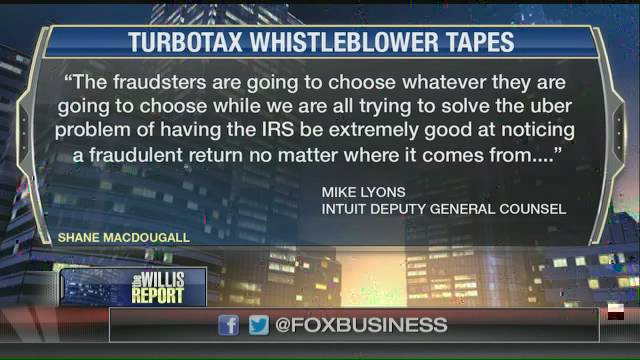
Conference call to one of the executives of Intuit, Mike Lyons, Intuit Deputy General Counsel:  “The fraudsters are going to choose whatever they are going to choose while we are all trying to solve the uber problem of having the IRS be extremely good at noticing a fraudulent return no matter where it comes from….We want the IRS good enough to notice the abstract patterns and shut it down at the source.  Not based on whether any one particular vendor built the better mousetrap than the other.”

Willis:  Adam, you look at this all the time.  The IRS, of course, is in charge of making sure that tax returns are true, and Intuit, for its part, says it’s not our job to monitor this.  What’s your response?

Adam Levin:  I think it’s everybody’s job.  Every time any corporation doesn’t properly secure personal identifying information for people, any time that any corporation is really part of a problem, whether it created it or not, we’re in this together.  Without collaboration, cooperation, communication, without sharing threat assessment information, we’re never going to get a handle on this.

And one last thing on this, combine that with the fact that because of sequestration, the IRS has actually been cut back, which forced it to cut back its enforcement activities.

Willis:  That’s their excuse, that they don’t have enough money to do what they need to do.

snapshot3

…Chart “Total Turbotax customer growth”.  What you see in this chart is an incredible boom in what’s called multi filer customer growth.  That’s really the suspicious filer out there.  You see that grow over time.  Why did that happen to Turbotax?  Is it just because they are the biggest guy on the block or were they really doing something that courted that business?

Shane McDougall:  If you listen to the rest of that tape, you’ll literally hear the deputy counsel and also the director of the company talking about how they had cracked down on fraud, they saw their revenue drop, the amount of tax fraud reported to the IRS did not go down, so they said, “Well, you know, all we did was the tax fraud went somewhere else.”

And the reality is they did have the ability to cut back on fraud:   in fact, they did, and they saw the fraud go elsewhere.   So what they did was roll back the alerting of the IRS and literally they rolled back the protections, the things that were shutting fraud down.  They literally say in that tape that fraud fell off a cliff.  It can’t be any clearer than that.  And the very fact that they had stopped the fraud, then allowed it again, to me makes them accessories before the fact.

Willis:  …There’s a lot of interest in this story. …a lot of people are investigating this.

snapshot9

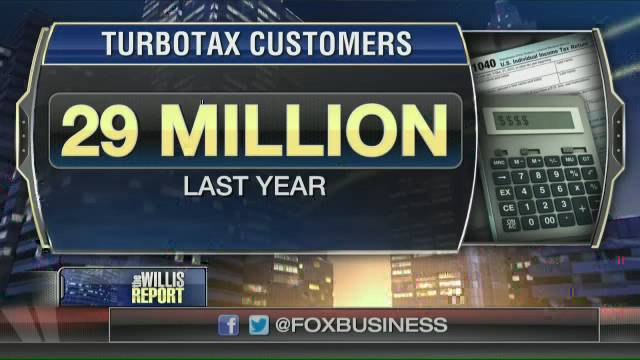
Turbotax is huge:  29 million customers last year.  If there’s going to be fraud in the system, it is going to be right through Turbotax because it’s so big.

snapshot19

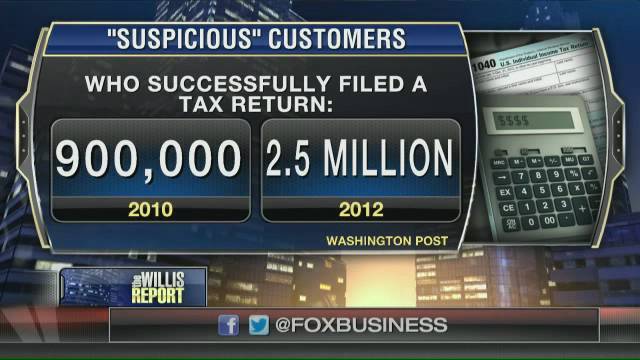
The proportion of suspicious customers who successfully filed a tax return:  in 2010, 900,000.  In 2012, it jumps to 2.5 million.  What does that tell you, Adam?

Adam:  That tells me that the filtering systems are not filtering.  And as was said, when they see suspicious activity–and they see, for instance, multiple people using the same social security number–what does someone have to do?  Run a billboard in front of you to get you to do something about it?

Willis:  Is it that hard to track down?  Are you telling me it should be easy to see?

Adam:  It should be easier to see than apparently it is.  There’s no excuse for this.  That we all have to toughen up, we have to tighten up:  states, the IRS, the tax preparers, and the self tax preparation organizations like Turbotax.

snapshot15

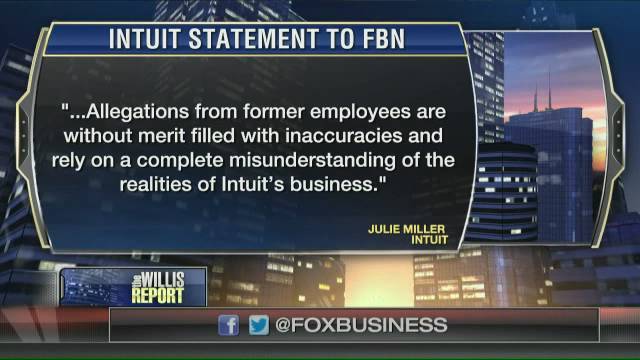
Intuit Statement to FBN from Julie Miller at Intuit:  “…Allegations from former employees are without merit filled with inaccuracies and rely on a complete misunderstanding of the realities of Intuit’s business.”

Shane:  That graph that you showed earlier was from a planning document that went all the way up to the CEO.  And if you look at the very last chart, they not only knew how much fraud happened in the past, if you compare the numbers in that chart to what the actual report to the SEC, the numbers align perfectly.

And in that final bar, that final bar of the chart, they actually were saying how much fraud that they are going to cook in.  And they were saying one to one-and-one-half million highly suspicious filings.  That means, when we say highly suspicious, it’s fraud.  And they were actually baking those into the numbers.

Willis:  Shane, you say they’re baking it into that numbers, and that goes basically to your allegation essentially that this is something that they are banking on, they actually are counting on as revenues.

Americans are filing their taxes right now.  They don’t want to lose money.  They don’t want to lose that refund.  What’s your advice?

Adam:  You need to file early.  And you need to make sure that when you use these tax preparation services, you use long and strong alphanumeric passwords that can’t be easily deciphered.  You cannot use user name and password universally through your network of social networking, emails, financial services.  Tax should be very very special.  And also don’t save any tax preparation on your computer:  put it on an encrypted thumb drive and when you finish using whatever, don’t keep it on your computer because your computer could get hacked.

Shane:  Better yet, file by paper.

The Barefoot Accountant:  The above-mentioned “transcript” is not complete and may contain errors.  Please refer to the video tape for completeness and accuracy.

Posted in Accountants CPA Hartford, Articles | Tagged , , , , , , , , , , , , , , , , , , , , , , , , , , , , , , | Leave a comment

TurboTax’s Anti-Fraud Efforts Under Scrutiny

TurboTax’s Anti-Fraud Efforts Under Scrutiny

Two former security employees at Intuit — the makers of the popular tax preparation software and service TurboTax – allege that the company has made millions of dollars knowingly processing state and federal tax refunds filed by cybercriminals. Intuit says it leads the industry in voluntarily reporting suspicious returns, and that ultimately it is up to theInternal Revenue Service to develop industry-wide requirements for tax preparation firms to follow in their fight against the multi-billion dollar problem of tax refund fraud.

Last week, KrebsOnSecurity published an exclusive interview with Indu Kodukula, Intuit’s chief information security officer. Kodukula explained that customer password re-use was a major cause of a spike this tax season in fraudulent state tax refund requests. The increase in phony state refund requests prompted several state revenue departments to complain to their state attorneys general. In response, TurboTax temporarily halted all state filings while it investigated claims of a possible breach. The company resumed state filing shortly after that pause, saying it could find no evidence that customers’ TurboTax credentials had been stolen from its network.

Kodukula noted that although the incidence of hijacked, existing TurboTax accounts was rapidly growing, the majority of refund scams the company has to deal with stem from “stolen identity refund fraud” or SIRF. In SIRF, the thieves gather pieces of data about taxpayers from outside means — through phishing attacks or identity theft services in the underground, for example — then create accounts at TurboTax in the victims’ names and file fraudulent tax refund claims with the IRS.

Kodukula cast Intuit as an industry leader in helping the IRS identify and ultimately deny suspicious tax returns. But that portrayal only tells part of the story, according to two former Intuit employees who until recently each held crucial security positions helping the company identify and fight tax fraud. Both individuals described a company that has intentionally dialed back efforts to crack down on SIRF so as not to lose market share when fraudsters began shifting their business to Intuit’s competitors.

Robert Lee, a security business partner at Intuit’s consumer tax group until his departure from the company in July 2014, said he and his team at Intuit developed sophisticated fraud models to help Intuit quickly identify and close accounts that were being used by crooks to commit massive amounts of SIRF fraud.

But Lee said he was mystified when Intuit repeatedly refused to adopt some basic policies that would make it more costly and complicated for fraudsters to abuse the company’s service for tax refund fraud, such as blocking the re-use of the same Social Security number across a certain number of TurboTax accounts, or preventing the same account from filing more than a small number of tax returns.

We found literally millions of accounts that were 100 percent used only for fraud. But management explicitly forbade us from either flagging the accounts as fraudulent, or turning off those accounts.

“If I sign up for an account and file tax refund requests on 100 people who are not me, it’s obviously fraud,” Lee said in an interview with KrebsOnSecurity. “We found literally millions of accounts that were 100 percent used only for fraud. But management explicitly forbade us from either flagging the accounts as fraudulent, or turning off those accounts.

The allegations surface just days after Senate Finance Committee Chairman Orrin Hatch (R., Utah) said his panel will be holding hearings on reports about a spike in fraudulent filings through TurboTax and elsewhere. The House Ways and Means Committee is reportedly looking into the matter and has held bipartisan staff-level discussions with the IRS and Intuit.

The Federal Trade Commission (FTC) said it received 332,646 identity theft complaints in the calendar year 2014, and that almost one-third of them — the largest portion — were tax-related identity theft complaints. Tax identity theft has been the largest ID theft category for the last five years.

According to a recent report (PDF) from the U.S. Government Accountability Office(GAO), the IRS estimated it prevented $24.2 billion in fraudulent identity theft refunds in 2013.  Unfortunately, the IRS also paid $5.8 billion that year for refund requests later determined to be fraud. The GAO noted that because of the difficulties in knowing the amount of undetected fraud, the actual amount could far exceed those estimates.

SQUEEZING THE BALLOON

Lee said the scammers who hijack existing TurboTax accounts most often will use stolen credit cards to pay the $25-$50 TurboTax fee for processing and sending the refund request to the IRS.

But he said the crooks perpetrating SIRF typically force the IRS — and, by extension, U.S. taxpayers — to cover the fee for their bogus filings. That’s because most SIRF filings take advantage of what’s known in the online tax preparation business as a ‘refund transfer’, which deducts TurboTax’s filing fee from the total amount of the fraudulent refund request. If the IRS then approves the fraudulent return, TurboTax gets paid.

“The reason fraudsters love this system is because they don’t even have to use stolen credit cards to do it,” Lee said. “What’s really going on here is that the fraud business is actually profitable for Intuit.”

Lee confirmed Kodukula’s narrative that Intuit is an industry leader in sending the IRS regular reports about tax returns that appear suspicious. But he said the company eventually scaled back those reports after noticing that the overall fraud the IRS was reporting wasn’t decreasing as a result of Intuit’s reporting: Fraudsters were simply taking their business to Intuit’s competitors.

We started to see not only our fraud numbers but also our revenue go down before the peak of tax season a couple of years ago,” Lee recalled. “When we stopped or delayed sending those fraud numbers, we saw the fraud and our revenue go back up.

“We noticed the IRS started taking action, and because of this, we started to see not only our fraud numbers but also our revenue go down before the peak of tax season a couple of years ago,” Lee recalled. “When we stopped or delayed sending those fraud numbers, we saw the fraud and our revenue go back up.

Lee said that early on, the reports on returns that Intuit’s fraud teams flagged as bogus were sent immediately to the IRS.

“Then, there was a time period where we didn’t deliver that information at all,” he said. “And then at one point there was a two-week delay added between the time the information was ready and the time it was submitted to the IRS. There was no technical reason for that delay, but I can only speculate what the real justification for that was.”

KrebsOnSecurity obtained a copy of a recording made of an internal Intuit conference call on Oct. 14, 2014, in which Michael Lyons, TurboTax’s deputy general counsel, describes the risks of the company being overly aggressive — relative to its competitors — in flagging suspicious tax returns for the IRS.

“As you can imagine, the bad guys being smart and savvy, they saw this and noticed it, they just went somewhere else,” Lyons said in the recording. “The amount of fraudulent activity didn’t change. The landscape didn’t change. It was like squeezing a balloon. They recognized that TurboTax returns were getting stopped at the door. So they said, ‘We’ll just go over toH&R Block, to TaxSlayer or TaxAct, or whatever.’ And all of a sudden we saw what we call ‘multi-filer activity’ had completely dropped off a cliff but the amount that the IRS reported coming through digital channels and through their self reported fraud network was not changing at all. The bad guys had just gone from us to others.”

That recording was shared by Shane MacDougall, formerly a principal security engineer at Intuit. MacDougall resigned from the company last week and filed an official whistleblower complaint with the U.S. Securities and Exchange Commission, alleging that the company routinely placed profits ahead of ethics. MacDougall submitted the recording in his filing with the SEC.

“Complainant repeatedly raised issues with managers, directors, and even [a senior vice president] of the company to try to rectify ongoing fraud, but was repeatedly rebuffed and told Intuit couldn’t do anything that would ‘hurt the numbers’,” MacDougall wrote in his SEC filing. “Complainant repeatedly offered solutions to help stop the fraud, but was ignored.”

NO RULES OF THE ROAD

For its part, Intuit maintains that it is well out in front of its competitors in voluntarily reporting to the IRS refund requests that the company has flagged as suspicious. The company also stresses that it has done so even though the IRS still has not promulgated rules that require TurboTax and its competitors to report suspicious returns  — or even how to report such activity. Intuit executives say they went to the IRS three years ago to request specific authority to share that information. The IRS did not respond to requests for comment.

Intuit officials declined to address Lyons’ recorded comments specifically, although they did confirm that a company attorney led an employee WebEx meeting on the date the recording was made. But David Williams, Intuit’s chief tax officer, said what’s missing from the recorded conversation excerpted above is that Intuit has been at the forefront of asking the IRS to propose industry standards that every industry player can follow — requests that have so far gone unheeded.

“We have led the industry in making suspicious activity reports, and I’d venture to say that virtually all of the returns that Mr. Lee is quoted as referring to appear in our suspicious activity reports and are stopped by the IRS,” Williams said. “Whatever else Mr. Lee may have seen, I’m not buying the premise that somehow there was a profit motive in it for us.”

Robert Lanesey, Inuit’s chief communications officer, said Intuit doesn’t make a penny on tax filings that are ultimately rejected by the IRS.

“Revenue that comes from reports included in our suspicious activity reports to the IRS has dropped precipitously as we have changed and improved our reporting mechanisms,” Lanesey said. “When it comes to market share, it doesn’t count toward our market share unless it’s a successful return. We’ve gotten better and we’ve gotten more accurate, but it’s not about money.”

“Revenue that comes from reports included in our suspicious activity reports to the IRS has dropped precipitously as we have changed and improved our reporting mechanisms,” Lanesey said. “When it comes to market share, it doesn’t count toward our market share unless it’s a successful return. We’ve gotten better and we’ve gotten more accurate, but it’s not about money.”

Williams added that it is not up to Intuit to block returns from being filed, and that it is the IRS’s sole determination whether to process a given refund request.

“We will flag them as suspicious, but we do not get to determine if a return is fraud,” Williams said. “It’s the IRS’s responsibility and ultimately they make that decision. What I will tell you is that of the ones we report as suspicious, the IRS rejects a very high percentage, somewhere in the 80-90 percent range.”

Earlier this month, Intuit CEO Brad Smith sent a letter to the commissioner of the IRS,  noting that while Intuit sends reports to the IRS when it sees patterns of suspicious behavior, the government has been limited in the types of information it can share with parties, including tax-preparation firms.

“The IRS could be the convener to bring the States together to help drive common standards adoption,” Smith wrote, offering the assistance of Intuit staff members “to work directly with the IRS and the States in whatever ways may be of assistance…as the fight against fraud goes forward.”

ZERO FALSE POSITIVES

Lee and MacDougall both said Intuit’s official approach to fighting fraud is guided by a policy of zero tolerance for so-called “false positives” — the problem of incorrectly flagging a legitimate customer refund request as suspicious, and possibly incurring the double whammy of a delay in the customer’s refund and an inquiry by the IRS. This is supported by audio recordings of conference calls between Intuit’s senior executives that were shared with KrebsOnSecurity.

“We protect the sanctity of the customer experience and hold it as inviolate,” Intuit’s General
Counsel Michael Lyons can be heard saying on a recorded October 2014 internal conference call. “We do everything we can to organize the best screening program we can, but we avoid false positives at all costs. Because getting a legitimate taxpayer ensnared in the ‘you’re a bad guy’ area with the IRS is hell. Once your return gets flagged as suspicious, rejected and the IRS starts investigating, you’re not in a good place. More than 50 percent of people out there are living paycheck to paycheck, and when this is the biggest paycheck of the year for them, they can’t afford to get erroneously flagged as fraud and have to prove to the IRS who they are so that they can get that legitimate refund that they were expecting months ago.”

On the same conference call, MacDougall can be heard asking Lyons why the company wouldn’t want to use security as a way to set the company apart from its competitors in the online tax preparation industry.

It is always possible for Intuit to build a better mousetrap. But because it doesn’t solve the systemic problem of bad guys doing this, all it really does is shoot us in the foot and make it slightly easier for IRS to continue to kick the can down the road.

“We don’t use security as a marketing tactic for Intuit,” Lyons explained. “We declared that this was one of our principles. It is always possible for Intuit to build a better mousetrap. But because it doesn’t solve the systemic problem of bad guys doing this, all it really does is shoot us in the foot and make it slightly easier for IRS to continue to kick the can down the road. What it does do is artificially harm our numbers and artificially inflate the competitive numbers associated with digital tax returns.”

Intuit’s Lanesey confirmed Lee’s claim that Intuit adds a delay — it is currently three weeks — from the time a customer files a refund claim and the time it transmits “scoring” data to the IRS intended to communicate which returns the company believes are suspicious. Lanesey said the delay was added specifically to avoid false positives.

“The reason we did that was that when we started this reporting, we weren’t accurate, and were ensnaring legitimate taxpayers in that process,” Lanesey said. “We slowed down and spent more time to review to make sure we could get more accurate and we have in fact done exactly that. The match rates between what the IRS rejects and what we send are now measurably higher today with the new reporting than they were then.”

Unfortunately, three weeks is about how long the IRS takes to decide whether to reject or approve tax refund requests. In an August 2014 report to Congress on the tax refund fraud epidemic, the GAO said that for 2014, the IRS informed taxpayers that it would generally issue refunds in less than 21 days after receiving a tax return — primarily because the IRS is required by law to pay interest if it takes longer than 45 days after the due date of the return to issue a refund.

Williams said Intuit is open to shortening its reporting delay.

“As we’ve gotten better at this and the IRS has gotten better at this, we can certainly look at shortening the timeframes,” he said. “Given the fact that over the past few years we’ve improved our speed, processes and techniques for reporting accurately, we can certainly explore whether they are able to take the data we give them and we are able to provide it to them in a way that is more useful.”

BUILDING A BETTER MOUSETRAP

The scourge of tax fraud is hardly a problem confined to TurboTax, but with nearly 29 million customers last year TurboTax is by far the biggest player in the market. In contrast, H&R Block and TaxAct each handled seven million prepared returns last year, according to figures collected by The Wall Street Journal.

Both Lee and MacDougall said they wanted to go public with their concerns because TurboTax and the rest of the industry  have for so long put off implementing stronger account security measures. MacDougall said he filed the whistleblower complaint with the SEC because he witnessed a pattern of activity within Intuit’s management that suggested the firm was not interested in stopping fraud if it meant throttling profits when none of its competitors were doing the same.

MacDougall said that about a year ago he had a meeting with the head of Intuit’s security division wherein security team members were asked to pitch their projects for the year. MacDougall said he thought his idea was certain to generate an enthusiastic response from higher-ups at the company: Build a fraud ‘honeypot.’

In information security terminology, a honeypot is a virtual holding area to which known or suspected fraudsters are redirected, so that their actions and activities can be monitored and mined for patterns that potentially aid in better identifying fraudulent activity. Honeypots also serve a more cathartic — albeit potentially just as useful — purpose: They tie up the time and attention of the fraudsters and cause them to waste tons of resources on fruitless activity.

“My project was going to be a fraud honeypot,” MacDougall recalled. “My pitch was that we would create a honeypot in TurboTax so that every time a fraudster came in and we figured it out, we’d switch them over to the honeypot version of the site so that we could waste their time, exhaust their resources, and at the end of the day they wouldn’t know they’d been scammed for several weeks, when they finally realized that none of their fraudulent returns had even been filed.”

But MacDougall said he was stunned when his boss emphatically rejected his idea for use on TurboTax accounts. Instead, she brought up the fraud-as-a-balloon analogy, MacDougall said.

“She said ‘You can use this on any other product except TurboTax’,” MacDougall said. “I asked why we wouldn’t want to use this on our flagship product, and her answer was that this was an industry problem and not just a TurboTax problem.”

whattodo copyOnly after Intuit was forced to temporarily suspend state filings earlier this month did the company’s chief executive announce plans to beef up the security of customer accounts. Intuit now says it plans to start requiring customers to validate their accounts, either via email, text message or by answering questions about their financial history relayed through the service by big-three credit bureau Experian.

Lee says those requirements are long overdue, but that they don’t go nearly far enough considering how much sensitive information Intuit holds about tens of millions of taxpayers.

“Tax preparers ought to apply similar ‘know your customer’ practices that we see in the financial markets,” he said. “When you give your most sensitive data and that of your family’s to a company, that company should offer you more security than you can get at Facebook or World of Warcraft,” Lee said, referring to two popular online businesses that have long offered the type of multi-factor authentication that Intuit just announced this month.

At a minimum, Lee said, tax preparation companies should require users to prove they have access to the phone number and email address that they assign to their account, and should bar multiple accounts from using the same phone number or email address. TurboTax and others also should allow only one account per Social Security number, he said.

“The point here is not to shame Intuit, but to educate the American public about what’s going on,” Lee said. “The industry as a whole, not just Intuit, needs to grow up and tackle this fraud problem seriously.”

Intuit’s David Williams said the company is focused on remedying some of the account issues raised by Lee and others.

“To be fair, our recent experience with the states has been a wake-up call that we are going to be more aggressive than anybody going forward, even if we were just acting consistently [with the rest of the industry] in the past,” he said. “That’s why we always talk about our anti-fraud efforts as evolving. We don’t have every great idea in the world, but we’re always looking at improving.”

Posted in Accountants CPA Hartford, Articles | Tagged , , , , , , , , , , | 1 Comment

TurboTax accounts hacked, delaying tax refunds, compromising personal information, impairing credit rating

taxreturnidentitytheftSo you want to file your taxes online by using TurboTax, by Intuit?  Perhaps you should think again.  An audacious gang of online criminals have been systematically targeting TurboTax, filing fraudulent tax returns of individuals, and diverting their tax refunds to prepaid debit cards. The vulnerability of online tax preparation services became apparent last month when the Utah Tax Commission and the Minnesota Department of Revenue found thousands of potentially fraudulent returns. Those returns were filed using TurboTax, the popular program made by Intuit.
This kind of fraud associated with fictitious tax returns has risen sharply in recent years with some states seeing a thirty-seven fold increase in fraudulent returns this year.  But Intuit does not immediately alert taxation authorities even after it flagged many of the returns as “suspicious,” denying its responsibility to determine whether these suspicious tax returns are fraudulent, reasoning that it could not stop fraud in the industry.

But critics said Intuit and other tax software providers have a responsibility to protect the integrity of the tax filing system. And several security experts said the company is only now adding security measures that have been used by e-mail and social-media companies for years.

“They [e.g., Intuit] can’t blame everything on the IRS. That’s ridiculous,” said Ed Mierzwinski, consumer program director at the U.S. Public Interest Research Group.

Among Intuit’s critics are two former employees who said they protested Intuit’s decision not to do more to halt seemingly fraudulent returns when they worked at the company.

One of them, Shane MacDougall, who was a principal security engineer at Intuit until last month, recently filed a whistleblower complaint with the Securities and Exchange Commission that alleges Intuit chose not to take needed security measures because executives worried those actions would cut into the company’s market share.

“One of the main reasons that I left was that Intuit was seemingly unwilling to implement even the most basic safeguards to protect their users that we were recommending,” MacDougall said. “Something like preventing multiple people from using the same Social Security number is extremely simple to do and that would stop a ton of fraud dead in its tracks, and that was one of many recommendations that we made that they would not implement.”

An internal strategy presentation obtained by The Washington Post showed that the number of “suspicious” customers who successfully filed a return grew from about 900,000 in 2010 to about 2.5 million in 2012. About 29 million people used TurboTax last year.

Intuit declined to comment about the document.

Tax entities have observed that Intuit and its rivals in the self-preparation software business — H&R Block and Blucora, the maker of TaxAct — do not have a financial incentive to erect the strongest possible security protections for consumers. Such steps can make accessing accounts less convenient.

“Commercial tax preparation software vendors have a much different primary objective than tax agencies. They are driven by profit,” Julie Magee, commissioner of the Alabama Department of Revenue, wrote in a public letter this week. “The easier they make it to file a return, the more customers they can get and the more profitable they will become. There is no incentive for them to stop fraud.”

The hackers who targeted TurboTax this year appeared to use two techniques. Some seemed to already have people’s personal information and created fake accounts to submit phony tax returns. Others figured out users’ log-ins and passwords, by trying multiple iterations, and gained wide access to their accounts.

Indeed, many Americans will not discover that they have been victimized until they attempt to file returns in the coming weeks.  And after they report the fraud to the IRS, it could be at least six months, if not much longer, before the agency is able o verify their identities and issue their refunds.  They are also often required to file their tax returns through paper.

In addition to the considerable delay in obtaining a tax refund, another concern resulting from hackers gaining access to one’s account on TurboTax is their access to one’s personal information, and the impairment of one’s credit rating.

So do you still want to file your tax returns using TurboTax ?  LOL!

Posted in Accountants CPA Hartford, Articles | Tagged , , , , , , , , , , , , , , , , , , , , | 1 Comment

Are accountants the future anthropologists of the cyber era?

Forty-nine years ago, when I was at the University of Connecticut, accountants and anthropologists seemed to be members of different social and intellectual tribes. The former appeared to be civilized folk who wore funny suits like penguins, used calculators or slide rules, and prepared tax returns; the latter worried about the environment and issues such as social welfare, and appeared in “The National Geographic” magazine with native women showing their titties.

Gillian TettBut are accountants about to leap into the sphere of anthropology, at least in an intellectual sense?  Gillian Tett, author of the recent article, “Accountancy: the new buzz“, found herself pondering “these questions after reading Six Capitals, or Can Accountants Save the Planet? by Australian business writer Jane Gleeson-White.”  What follows is the extract of her article suggesting that accountants may be the cyber era’s new anthropologists.  (LOL!  And I once thought my humanities and social science background was a waste of time and money!)

As the title suggests, the book is all about accountants. But not the dry number crunchers you might expect. Instead, Gleeson-White suggests that a mini-revolution is emerging on the fringes of the accountancy world — and that this has implications for us all.

The issue at stake is how we classify the world. Traditionally, the assumption has been that what accountants do is measure items that have clear, tangible value, sitting in bounded institutions or geographical areas: stock stored in warehouses, salaries, cash and so on. That was what the market economy and capitalism seemed to be about. What anthropologists or ecologists look at — such as the sustainability of the environment, human relations or social trust — is less tangible and, thus, usually ignored.

Gleeson-White believes the modern accounting practices we take for granted are the product of a particular economic environment, namely the industrial revolution. This system, known as double-entry bookkeeping, first appeared in 15th-century Venice. However, it really began to flourish when companies needed ways to measure their complex operations as they began to make vast quantities of products.

Double-entry bookkeeping worked well for the industrial age but is less effective in today’s digital world. The system does not really capture the value of the intangibles that drive modern growth (ideas, networks and human relations, for example). Nor does it measure costs that transcend boundaries, such as environmental problems or “externalities”, as economists like to say.

Gleeson-White argues that we need to change how accountants imagine capital to include human capital, social capital, environmental capital and so on. And she cites accountants who are doing just that. For example, companies such as Puma and Unilever are now actively looking at their environmental and social footprints, alongside the usual financial metrics.

Some years ago, Indian researchers attempted to quantify the environmental costs linked to a $4 hamburger (for example, loss of rainforests, loss of ecosystems provided by the rainforest, loss of carbon, loss of biodiversity etc) and concluded that the price of a burger should be nearer $200.

Governments have begun to play around with similar ideas. In 2007, the National Audit Office estimated the value of bees’ service to the British economy at £200m. The retail value of what the bees pollinate was estimated to be closer to £1bn.

“A quiet revolution [is] taking place in the least likely realm of all — our accounting systems,” Gleeson-White suggests. Now, I daresay that some FT readers will roll their eyes at this — albeit for different reasons. Many environmentalists consider it demeaning to put a price tag on nature; bees are not just valuable in financial terms. Conversely, many bankers and investment managers hate the concept of companies worrying about anything other than shareholders; they fear it will be distracting. And I admit that I often wince when companies talk too enthusiastically about their “social” or “environmental” responsibility. It often sounds like window dressing.

Nevertheless, it is worth taking Gleeson-White’s ideas seriously for one reason at least: they should make us think about how we measure and classify the world. This can be difficult for us to grasp, since our systems are so deeply ingrained that they seem normal. And most of us assume that it is quite natural for accountants to separate economic transactions from any social context.

In reality, though, as the French intellectual Marcel Mauss pointed out a century ago, the idea of ripping economic transactions out of a wider context is not “normal” to most cultures, during most of history. On the contrary, in most societies it is so hard to imagine economic transaction without social ties that the western idea that “gifts” are different from “commercial sales” is entirely alien.

So the next time you talk to an accountant, it is worth trying a little mental experiment. If you were to devise a system for classifying and measuring the world from scratch in a globalised cyber era, would it really look like what we have today? If your answer is “no”, then perhaps it is time to think of an alternative; and maybe even talk with an anthropologist.

Although east is east, and west is west, perhaps the twain may meet after all.

Posted in Accountants CPA Hartford, Articles | Tagged , , , , , , , , , | 1 Comment